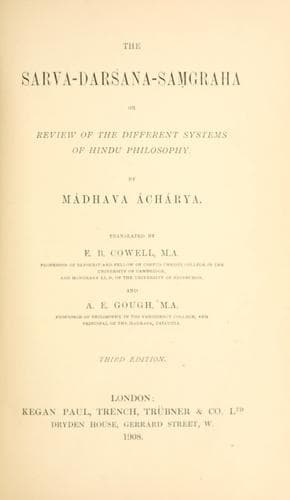
The Sarva-Darsana-Samgraha: Or, Review of the Different Systems of Hindu PhilosophyMadhava
ReligionEastern
The Sarva-Darsana-Samgraha: Or, Review of the Different Systems of Hindu Philosophy
Madhava
Philosophy, Hindu; Philosophy, Indic
Others, again (the followers of Śaṅkaráchárya), maintain that pure
intelligence, exempt from all differences, the absolute, alone is
really existent; and that this absolute whose essence is eternal,
pure, intelligent, and free, the identity of which with the
individuated spirit is learnt from the "reference to the same object"
(predication), "That art thou," undergoes bondage and emancipation.
The universe of differences (or conditions) such as that of subject
and object, is all illusorily imagined by illusion as in that (one
reality), as is attested by a number of texts: Existent only, fair
sir, was this in the beginning, One only without a second, and so
forth. Maintaining this, and acknowledging a suppression of this
beginningless illusion by knowledge of the unity (and identity) of
individuated spirits and the undifferenced absolute, in conformity
with hundreds of texts from the Upanishads, such as He that knows
spirit passes beyond sorrow; rejecting also any real plurality of
things, in conformity with the text condemnatory of duality, viz.,
Death after death he undergoes who looks upon this as manifold; and
thinking themselves very wise, the Śáṅkaras will not tolerate this
division (viz., the distribution of things into soul, not-soul, and
Lord). To all this the following counterposition is laid down:--This
might be all well enough if there were any proof of such illusion. But
there is no such ignorance (or illusion), an unbeginning entity,
suppressible by knowledge, testified in the perceptions, I am
ignorant, I know not myself and other things. Thus it has been said
(to explain the views of the Śáṅkara)--
"Entitative from everlasting, which is dissolved by
knowledge,
"Such is illusion. This definition the wise enunciate."
This perception (they would further contend) is not conversant about
the absence of knowledge. For who can maintain this, and to whom? One
who leans on the arm of Prabhákara, or one to whom Kumárila-bhaṭṭa
gives his hand? Not the former, for in the words--
"By means of its own and of another's form, eternal in the
existent and non-existent,
"Thing is recognised something by some at certain times.
"Non-entity is but another entity by some kind of relation.
Non-entity is but another entity, naught else, for naught
else is observed."
Public-domain text, read in full here on John Shaqi.
Reviews
Reviews
No reviews yet
Be the first to share your thoughts on this work.
Join the Discussion
Join the discussion
Sign in to leave a comment or review.
Sign InorCreate an account