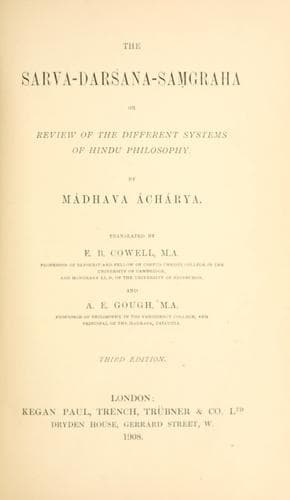
The Sarva-Darsana-Samgraha: Or, Review of the Different Systems of Hindu PhilosophyMadhava
ReligionEastern
The Sarva-Darsana-Samgraha: Or, Review of the Different Systems of Hindu Philosophy
Madhava
Philosophy, Hindu; Philosophy, Indic
They deny any non-entity ulterior to entity. Non-entity being
cognisable by the sixth instrument of knowledge (_anupalabdhi_), and
knowledge being always an object of inference, the absence of
knowledge cannot be an object of perception. If, again, any one who
maintains non-entity to be perceptible should employ the above
argument (from the perceptions, I am ignorant, I know not myself, and
other things); it may be replied: "Is there, or is there not, in the
consciousness, I am ignorant, an apprehension of self as characterised
by an absence, and of knowledge as the thing absent or non-existent?
If there is such apprehension, consciousness of the absence of
knowledge will be impossible, as involving a contradiction. If there
is not, consciousness of the absence of knowledge, which consciousness
presupposes a knowledge of the subject and of the thing absent, will
not readily become possible." Inasmuch (the Śáṅkaras continue) as the
foregoing difficulties do not occur if ignorance (or illusion) be
entitative, this consciousness (I am ignorant, I know not myself, and
other things) must be admitted to be conversant about an entitative
ignorance.
All this (the Rámánuja replies) is about as profitable as it would be
for a ruminant animal to ruminate upon ether; for an entitative
ignorance is not more supposable than an absence of knowledge. For (we
would ask), is any self-conscious principle presented as an object and
as a subject (of ignorance) as distinct from cognition? If it is
presented, how, since ignorance of a thing is terminable by knowledge
of its essence, can the ignorance continue? If none such is presented,
how can we be conscious of an ignorance which has no subject and no
object? If you say: A pure manifestation of the spiritual essence is
revealed only by the cognition opposed to ignorance (or illusion), and
thus there is no absurdity in the consciousness of ignorance
accompanied with a consciousness of its subject and object; then we
rejoin:--Unfortunately for you, this (consciousness of subject) must
arise equally in the absence of knowledge (for such we define illusion
to be), notwithstanding your assertion to the contrary. It must,
therefore, be acknowledged that the cognition, I am ignorant, I know
not myself and other things, is conversant about an absence of
cognition allowed by us both.
Public-domain text, read in full here on John Shaqi.
Reviews
Reviews
No reviews yet
Be the first to share your thoughts on this work.
Join the Discussion
Join the discussion
Sign in to leave a comment or review.
Sign InorCreate an account