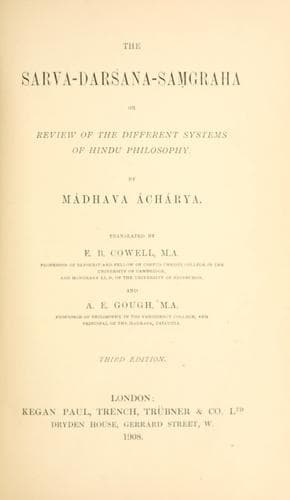
The Sarva-Darsana-Samgraha: Or, Review of the Different Systems of Hindu PhilosophyMadhava
ReligionEastern
The Sarva-Darsana-Samgraha: Or, Review of the Different Systems of Hindu Philosophy
Madhava
Philosophy, Hindu; Philosophy, Indic
Well, then (the Śáṅkaras may contend), let the form of cognition
evidentiary of illusion, which is under disputation, be inference, as
follows:--Right knowledge must have had for its antecedent another
entity (_sc._ illusion), an entity different from mere prior
non-existence of knowledge, which envelops the objects of knowledge,
which is terminable by knowledge, which occupies the place of
knowledge, inasmuch as it (the right knowledge) illuminates an object
not before illuminated, like the light of a lamp springing up for the
first time in the darkness. This argument (we reply) will not stand
grinding (in the dialectic mill); for to prove the (antecedent)
illusion, you will require an ulterior illusion which you do not
admit, and a violation of your own tenets will ensue, while if you do
not so prove it, it may or may not exist; and, moreover, the example
is incompatible with the argument, for it cannot be the lamp that
illumines the hitherto unillumined object, since it is knowledge only
that illumines; and an illumination of objects may be effected by
knowledge even without the lamp, while the light of the lamp is only
ancillary to the visual organ which effectuates the cognition,
ancillary mediately through the dispulsion of the obstruent darkness.
We dismiss further prolixity.
The counterposition (of the Rámánujas) is as follows:--The illusion
under dispute does not reside in Brahman, who is pure knowledge,
because it is an illusion, like the illusion about nacre, &c. If any
one ask: Has not the self-conscious entity that underlies the illusion
about nacre, &c., knowledge only for its nature? they reply: Do not
start such difficulties; for we suppose that consciousness by its bare
existence has the nature of creating conformity to the usage about
(_i.e._, the name and notion of) some object; and such consciousness,
also called knowledge, apprehension, comprehension, intelligence, &c.,
constitutes the soul, or knowledge, of that which acts and knows. If
any one ask: How can the soul, if it consists of cognition, have
cognition as a quality? they reply: This question is futile; for as a
gem, the sun, and other luminous things, existing in the form of
light, are substances in which light as a quality inheres--for light,
as existing elsewhere than in its usual receptacle, and as being a
mode of things though a substance, is still styled and accounted a
quality derived from determination by that substance,--so this soul,
while it exists as a self-luminous intelligence, has also intelligence
as its quality. Accordingly the Vedic texts: A lump of salt is always
within and without one entire mass of taste, so also this soul is
within and without an entire mass of knowledge; Herein this person is
itself a light; Of the knowledge of that which knows there is no
suspension; He who knows, smells this; and so also, This is the soul
which, consisting of knowledge, is the light within the heart; For
Public-domain text, read in full here on John Shaqi.
Reviews
Reviews
No reviews yet
Be the first to share your thoughts on this work.
Join the Discussion
Join the discussion
Sign in to leave a comment or review.
Sign InorCreate an account