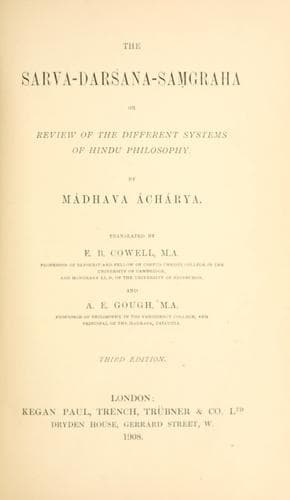
The Sarva-Darsana-Samgraha: Or, Review of the Different Systems of Hindu PhilosophyMadhava
ReligionEastern
The Sarva-Darsana-Samgraha: Or, Review of the Different Systems of Hindu Philosophy
Madhava
Philosophy, Hindu; Philosophy, Indic
this person is the seer, the hearer, the taster, the smeller, the
thinker, the understander, the doer; The person is knowledge, and the
like texts.
It is not to be supposed that the Veda also affords evidence of the
existence of the cosmical illusion, in the text, Enveloped in untruth
(_anṛita_); for the word untruth (_anṛita_) denotes that which is
other than truth (_ṛita_). The word _ṛita_ has a passive sense, as
appears from the words, Drinking _ṛita_. _Ṛita_ means works done
without desire of fruit; having as its reward the attainment of the
bliss of the Supreme Spirit through his propitiation. In the text in
question, untruth (_anṛita_) designates the scanty fruit enjoyed
during transmigratory existence as opposed to that (which results from
propitiation of the Supreme Spirit), which temporal fruit is
obstructive to the attainment of supreme existence (_brahman_); the
entire text (when the context is supplied) being: They who find not
this supreme sphere (_brahma-loka_) are enveloped in untruth. In such
texts, again, as Let him know illusion (_máyá_) to be the primary
emanative cause (_prakṛiti_), the term (_máyá_) designates the
emanative cause, consisting of the three "cords" (_guṇa_), and
creative of the diversified universe. It does not designate the
inexplicable illusion (for which the Śáṅkaras contend).
In such passages as, By him the defender of the body of the child,
moving rapidly, the thousand illusions (_máyá_) of the barbarian were
swooped upon as by a hawk, we observe that the word "illusion"
(_máyá_) designates the really existent weapon of a Titan, capable of
projective diversified creation. The Veda, then, never sets out an
inexplicable illusion. Nor (is the cosmical illusion to be inferred
from the "grand text," That art thou), inasmuch as the words, That art
thou, being incompetent to teach unity, and indicating a conditionate
Supreme Spirit, we cannot understand by them the essential unity of
the mutually exclusive supreme and individual spirits; for such a
supposition (as that they are identical) would violate the law of
excluded middle. To explain this. The term That denotes the Supreme
Spirit exempt from all imperfections, of illimitable excellence, a
repository of innumerable auspicious attributes, to whom the
emanation, sustentation, retractation of the universe is a
pastime;[108] such being the Supreme Spirit, spoken of in such texts
as, That desired, let me be many, let me bring forth. Perhaps the word
Thou, referring to the same object (as the word That), denotes the
Supreme Spirit characterised by consciousness, having all individual
spirits as his body; for a "reference to the same object" designates
one thing determined by two modes. Here, perhaps, an Advaita-vádin may
reply: Why may not the purport of the reference to the same object in
the words, That art thou, be undifferenced essence, the unity of
souls, these words (That and thou) having a (reciprocally) implicate
Public-domain text, read in full here on John Shaqi.
Reviews
Reviews
No reviews yet
Be the first to share your thoughts on this work.
Elsewhere in the archive
Join the Discussion
Join the discussion
Sign in to leave a comment or review.
Sign InorCreate an account