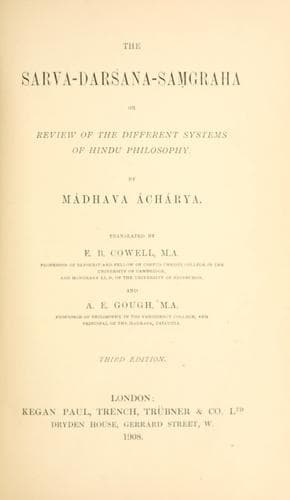
The Sarva-Darsana-Samgraha: Or, Review of the Different Systems of Hindu PhilosophyMadhava
ReligionEastern
The Sarva-Darsana-Samgraha: Or, Review of the Different Systems of Hindu Philosophy
Madhava
Philosophy, Hindu; Philosophy, Indic
power by abandonment of opposite portions of their meaning; as is the
case in the phrase, This is that Devadatta. In the words, This is that
Devadatta, we understand by the word That, a person in relation to a
different time and place, and by the word This, a person in relation
to the present time and place. That both are one and the same is
understood by the form of predication ("reference to the same
object"). Now as one and the same thing cannot at the same time be
known as in different times and places, the two words (This and That)
must refer to the essence (and not to the accidents of time and
place), and unity of essence can be understood. Similarly in the text,
That art thou, there is implicated an indivisible essence by
abandonment of the contradictory portions (of the denotation), viz.,
finite cognition (which belongs to the individual soul or Thou), and
infinite cognition (which belongs to the real or unindividual soul).
This suggestion (the Rámánujas reply) is unsatisfactory, for there is
no opposition (between This and That) in the example (This is that
Devadatta), and consequently not the smallest particle of
"implication" (_lakshaṇá_, both This and That being used in their
denotative capacity). The connection of one object with two times past
and present involves no contradiction. And any contradiction supposed
to arise from relation to different places may be avoided by a
supposed difference of time, the existence in the distant place being
past, and the existence in the near being present. Even if we concede
to you the "implication," the (supposed) contradiction being avoidable
by supposing one term (either That or Thou) to be implicative, it is
unnecessary to admit that both words are implicative. Otherwise (if we
admit that both words are implicative), if it be granted that the one
thing may be recognised, with the concomitant assurance that it
differs as this and as that, permanence in things will be
inadmissible, and the Buddhist assertor of a momentary flux of things
will be triumphant.
We have, therefore (the Rámánujas continue), laid it down in this
question that there is no contradiction in the identity of the
individual and the Supreme Spirit, the individual spirits being the
body and the Supreme Spirit the soul. For the individual spirit as the
body, and therefore a form, of the Supreme Spirit, is identical with
the Supreme Spirit, according to another text, Who abiding in the
soul, is the controller of the soul, who knows the soul, of whom soul
is the body.
Your statement of the matter, therefore, is too narrow. ALL words are
designatory of the Supreme Spirit. They are not all synonymous, a
variety of media being possible; thus as all organised bodies, divine,
human, &c., are forms of individual spirits, so all things (are the
body of Supreme Spirit), all things are identical with Supreme Spirit.
Hence--
Public-domain text, read in full here on John Shaqi.
Reviews
Reviews
No reviews yet
Be the first to share your thoughts on this work.
Elsewhere in the archive
Join the Discussion
Join the discussion
Sign in to leave a comment or review.
Sign InorCreate an account