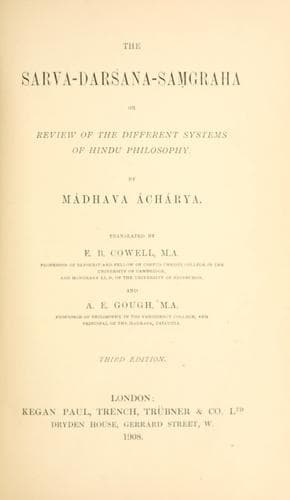
The Sarva-Darsana-Samgraha: Or, Review of the Different Systems of Hindu PhilosophyMadhava
ReligionEastern
The Sarva-Darsana-Samgraha: Or, Review of the Different Systems of Hindu Philosophy
Madhava
Philosophy, Hindu; Philosophy, Indic
God, Man, Yaksha, Piśácha, serpent, Rákshasa, bird, tree, creeper,
wood, stone, grass, jar, cloth,--these and all other words, be they
what they may, which are current among mankind as denotative by means
of their base and its suffixes, as denoting those things, in denoting
things of this or that apparent constitution, really denote the
individual souls which assumed to them such body, and the whole
complexus of things terminating in the Supreme Spirit ruling within.
That God and all other words whatsoever ultimately denote the Supreme
Spirit is stated in the Tattva-muktávalí and in the Chaturantara--
"God, and all other words, designate the soul, none else
than That, called the established entity,
"Of this there is much significant and undoubted
exemplification in common speech and in the Veda;
"Existence when dissociated from spirit is unknown; in the
form of gods, mortals, and the rest
"When pervading the individual spirit, the infinite has made
a diversity of names and forms in the world."
In these words the author, setting forth that all words, God, and the
rest, designate the body, and showing in the words, "No unity in
systems," &c., the characteristic of body, and showing in the words,
"By words which are substitutes for the essence of things," &c., that
it is established that nothing is different from the universal Lord,
lays down in the verses, Significant of the essence, &c., that all
words ultimately designate the Supreme Spirit. All this may be
ascertained from that work. The same matter has been enforced by
Rámánuja in the Vedártha-saṅgraha, when analysing the Vedic text about
names and forms.
Moreover, every form of evidence having some determinate object, there
can be no evidence of an undetermined (unconditionate) reality. Even
in non-discriminative perception it is a determinate (or conditioned)
thing that is cognised. Else in discriminative perception there could
not be shown to be a cognition characterised by an already presented
form. Again, that text, That art thou, is not sublative of the
universe as rooted in illusion, like a sentence declaratory that what
was illusorily presented, as a snake is a piece of rope; nor does
knowledge of the unity of the absolute and the soul bring (this
illusory universe) to an end; for we have already demonstrated that
there is no proof of these positions.
Public-domain text, read in full here on John Shaqi.
Reviews
Reviews
No reviews yet
Be the first to share your thoughts on this work.
Elsewhere in the archive
Join the Discussion
Join the discussion
Sign in to leave a comment or review.
Sign InorCreate an account