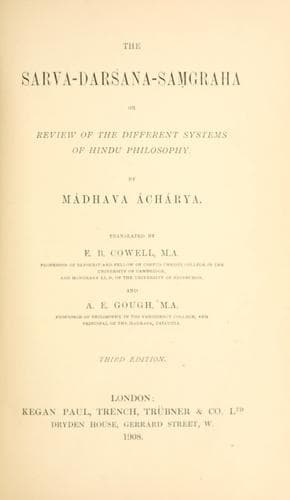
The Sarva-Darsana-Samgraha: Or, Review of the Different Systems of Hindu PhilosophyMadhava
ReligionEastern
The Sarva-Darsana-Samgraha: Or, Review of the Different Systems of Hindu Philosophy
Madhava
Philosophy, Hindu; Philosophy, Indic
Nor is there an absurdity (as the Śáṅkaras would say), on the
hypothesis enunciatory of the reality of the universe, in affirming
that by a cognition of one there is a cognition of all things: for it
is easily evinced that the mundane egg, consisting of the primary
cause (_prakṛiti_), intellect, self-position, the rudimentary
elements, the gross elements, the organs (of sense and of action), and
the fourteen worlds, and the gods, animals, men, immovable things, and
so forth, that exist within it, constituting a complex of all forms,
is all an effect, and that from the single cognition of absolute
spirit as its (emanative) cause, when we recognise that all this is
absolute spirit (there being a tautology between cause and effect),
there arises cognition of all things, and thus by cognition of one
cognition of all. Besides, if all else than absolute spirit were
unreal, then all being non-existent, it would follow that by one
cognition all cognition would be sublated.
It is laid down (by the Rámánujas) that retractation into the universe
(_pralaya_) is when the universe, the body whereof consists of souls
and the originant (_prakṛiti_), returns to its imperceptible state,
unsusceptible of division by names and forms, existing as absolute
spirit the emanative cause; and that creation (or emanation) is the
gross or perceptible condition of absolute spirit, the body whereof is
soul and not soul divided by diversity of names and forms, in the
condition of the (emanative) effect of absolute spirit. In this way
the identity of cause and effect laid down in the aphorism (of Vyása)
treating of origination, is easily explicable. The statements that the
Supreme Spirit is void of attributes, are intended (it is shown) to
deny thereof phenomenal qualities which are to be escaped from by
those that desire emancipation. The texts which deny plurality are
explained as allowed to be employed for the denial of the real
existence of things apart from the Supreme Spirit, which is identical
with all things, it being Supreme Spirit which subsists under all
forms as the soul of all, all things sentient and unsentient being
forms as being the body of absolute Spirit.[109]
What is the principle here involved, pluralism or monism, or a
universe both one and more than one? Of these alternatives monism is
admitted in saying that Supreme Spirit alone subsists in all forms as
all is its body; both unity and plurality are admitted in saying that
one only Supreme Spirit subsists under a plurality of forms diverse as
soul and not-soul; and plurality is admitted in saying that the
essential natures of soul, not-soul, and the Lord, are different, and
not to be confounded.
Public-domain text, read in full here on John Shaqi.
Reviews
Reviews
No reviews yet
Be the first to share your thoughts on this work.
Elsewhere in the archive
Join the Discussion
Join the discussion
Sign in to leave a comment or review.
Sign InorCreate an account