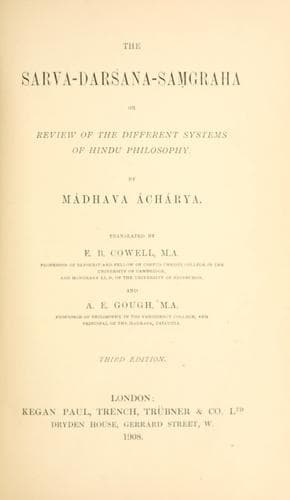
The Sarva-Darsana-Samgraha: Or, Review of the Different Systems of Hindu PhilosophyMadhava
ReligionEastern
The Sarva-Darsana-Samgraha: Or, Review of the Different Systems of Hindu Philosophy
Madhava
Philosophy, Hindu; Philosophy, Indic
Of these (soul, not-soul, and the Lord), individual spirits, or souls,
consisting of uncontracted and unlimited pure knowledge, but enveloped
in illusion, that is, in works from all eternity, undergo contraction
and expansion of knowledge according to the degrees of their merits.
Soul experiences fruition, and after reaping pleasures and pains
proportionate to merits and demerits, there ensues knowledge of the
Lord, or attainment of the sphere of the Lord. Of things which are
not-soul, and which are objects of fruition (or experience of pleasure
and pain), unconsciousness, unconduciveness to the end of man,
susceptibility of modification, and the like, are the properties. Of
the Supreme Lord the attributes are subsistence, as the internal
controller (or animator) of both the subjects and the objects of
fruition; the boundless glory of illimitable knowledge, dominion,
majesty, power, brightness, and the like, the countless multitude of
auspicious qualities; the generation at will of all things other than
himself, whether spiritual or non-spiritual; various and infinite
adornment with unsurpassable excellence, singular, uniform, and
divine.
Veṅkaṭa-nátha has given the following distribution of things:--
"Those who know it have declared the principle to be
twofold, substance and non-substance;
"Substance is dichotomised as unsentient and sentient; the
former being the unevolved (_avyakta_), and time.
"The latter is the 'near' (_pratyak_) and the 'distant'
(_parák_); the 'near' being twofold, as either soul or the
Lord;
"The 'distant' is eternal glory and intelligence; the other
principle some have called the unsentient primary."
Of these--
"Substance undergoes a plurality of conditions; the
originant is possessed of goodness and the other cords;
"Time has the form of years, &c.; soul is atomic and
cognisant; the other spirit is the Lord;
"Eternal bliss has been declared as transcending the three
cords (or modes of phenomenal existence), and also as
characterised by goodness;
"The cognisable manifestation of the cognisant is
intelligence; thus are the characteristics of substance
summarily recounted."
Of these (soul, not-soul, and the Lord), individual spirits, called
souls, are different from the Supreme Spirit and eternal. Thus the
text: Two birds, companions, friends, &c. (Rig-Veda, i. 164, 20).
Accordingly it is stated (in the aphorisms of Kaṇáda, iii. 2, 20),
Souls are diverse by reason of diversity of conditions. The eternity
of souls is often spoken of in revelation--
"The soul is neither born, nor dies, nor having been shall
it again cease to be;
"Unborn, unchanging, eternal, this ancient of days is not
killed when the body is killed" (Bhagavad-gítá, ii. 20).
Public-domain text, read in full here on John Shaqi.
Reviews
Reviews
No reviews yet
Be the first to share your thoughts on this work.
Elsewhere in the archive
Join the Discussion
Join the discussion
Sign in to leave a comment or review.
Sign InorCreate an account