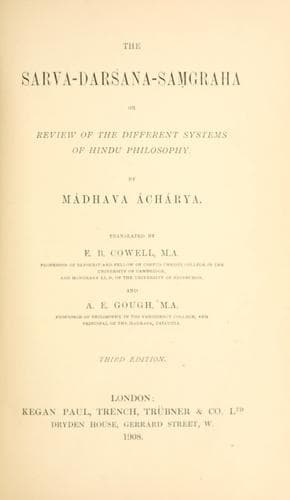
The Sarva-Darsana-Samgraha: Or, Review of the Different Systems of Hindu PhilosophyMadhava
ReligionEastern
The Sarva-Darsana-Samgraha: Or, Review of the Different Systems of Hindu Philosophy
Madhava
Philosophy, Hindu; Philosophy, Indic
Otherwise (were the soul not eternal) there would follow a failure of
requital and a fruition (of pleasures and pains) unmerited. It has
accordingly been said (in the aphorisms of Gautaṃa, iii. 25): Because
no birth is seen of one who is devoid of desire. That the soul is
atomic is well known from revelation--
"If the hundredth part of a hair be imagined to be divided a
hundred times,
"The soul may be supposed a part of that, and yet it is
capable of infinity."
And again--
"Soul is of the size of the extremity of the spoke of a
wheel. Spirit is to be recognised by the intelligence as
atomic."
The visible, unsentient world, designated by the term not-soul, is
divided into three, as the object, the instrument, or the site of
fruition. Of this world the efficient and substantial cause is the
Deity, known under the names Purushottama (best of spirits), Vásudeva
(a patronymic of Kṛishṇa), and the like.
"Vásudeva is the supreme absolute spirit, endowed with
auspicious attributes,
"The substantial cause, the efficient of the worlds, the
animator of spirits."
This same Vásudeva, infinitely compassionate, tender to those devoted
to him, the Supreme Spirit, with the purpose of bestowing various
rewards apportioned to the deserts of his votaries in consequence of
pastime, exists under five modes, distinguished as "adoration"
(_archá_), "emanation" (_vibhava_), "manifestation" (_vyúha_), "the
subtile" (_súkshma_), and the "internal controller." (1.) "Adoration"
is images, and so forth. (2.) "Emanation" is his incarnation, as Ráma,
and so forth. (3.) His "manifestation" is fourfold, as Vásudeva,
Saṅkarshaṇa, Pradyumna, and Aniruddha. (4.) "The subtile" is the
entire Supreme Spirit, with six attributes, called Vásudeva. His
attributes are exemption from sin, and the rest. That he is exempt
from sin is attested in the Vedic text: Passionless, deathless,
without sorrow, without hunger, desiring truth, true in purpose. (5.)
The "internal controller," the actuator of all spirits, according to
the text: Who abiding in the soul, rules the soul within. When by
worshipping each former embodiment a mass of sins inimical to the end
of the soul (_i.e._, emancipation) have been destroyed, the votary
becomes entitled to practise the worship of each latter embodiment. It
has, therefore, been said--
"Vásudeva, in his tenderness to his votaries, gives, as
desired by each,
"According to the merits of his qualified worshippers, large
recompense.
"For that end, in pastime he makes to himself his five
embodiments;
"Images and the like are 'adoration;' his incarnations are
'emanations;'
"As Saṅkarshaṅa, Vásudeva, Pradyumna, Aniruddha, his
manifestation is to be known to be fourfold; 'the subtile'
is the entire six attributes;
"That self-same called Vásudeva is styled the Supreme
Spirit;
Public-domain text, read in full here on John Shaqi.
Reviews
Reviews
No reviews yet
Be the first to share your thoughts on this work.
Elsewhere in the archive
Join the Discussion
Join the discussion
Sign in to leave a comment or review.
Sign InorCreate an account