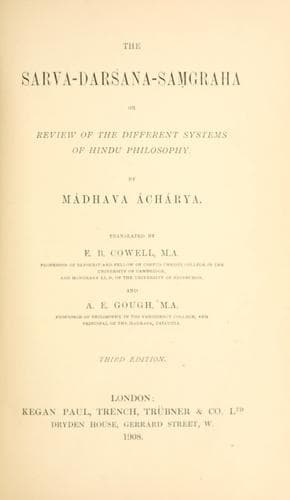
The Sarva-Darsana-Samgraha: Or, Review of the Different Systems of Hindu PhilosophyMadhava
ReligionEastern
The Sarva-Darsana-Samgraha: Or, Review of the Different Systems of Hindu Philosophy
Madhava
Philosophy, Hindu; Philosophy, Indic
"The internal controller is declared as residing in the
soul, the actuator of the soul,
"Described in a multitude of texts of the Upanishads, such
as 'Who abiding in the soul.'
"By the worship of 'adoration,' a man casting off his
defilement becomes a qualified votary;
"By the subsequent worship of 'emanation,' he becomes
qualified for the worship of 'manifestation;' next,
"By the worship thereafter of 'the subtile,' he becomes able
to behold the 'internal controller.'"
The worship of the Deity is described in the Pañcha-rátra as
consisting of five elements, viz., (1.) the access, (2.) the
preparation, (3.) oblation, (4.) recitation, (5.) devotion. Of these,
access is the sweeping, smearing, and so forth, of the way to the
temple. The preparation is the provision of perfumes, flowers, and the
like appliances of worship. Oblation is worship of the deities.
Recitation is the muttered ejaculation of sacred texts, with attention
to what they mean, the rehearsal of hymns and lauds of Vishṇu, the
commemoration of his names, and study of institutes which set forth
the truth. Devotion is meditation on the Deity. When the vision of the
visible world has been brought to a close by knowledge accumulated by
the merit of such worship, the infinitely compassionate Supreme
Spirit, tender to his votaries, bestows upon the votary devoted to his
lord and absorbed in his lord, his own sphere infinite and endless,
marked by consciousness of being like him, from which there is no
future return (to the sorrows of transmigratory existence). So the
traditionary text--
"When they have come to me, the high-souled no longer
undergo future birth, a receptacle of pain, transitory,
having attained to the supreme consummation.
"Vásudeva, having found his votary, bestows upon him his own
mansion, blissful, undecaying, from whence there is no more
return."
Public-domain text, read in full here on John Shaqi.
Reviews
Reviews
No reviews yet
Be the first to share your thoughts on this work.
Elsewhere in the archive
Join the Discussion
Join the discussion
Sign in to leave a comment or review.
Sign InorCreate an account