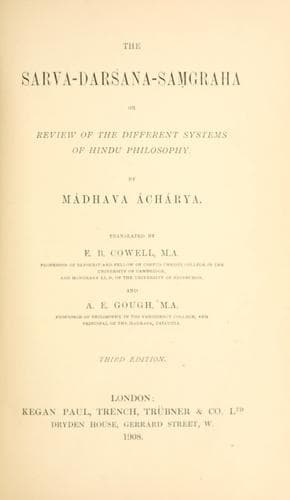
The Sarva-Darsana-Samgraha: Or, Review of the Different Systems of Hindu PhilosophyMadhava
ReligionEastern
The Sarva-Darsana-Samgraha: Or, Review of the Different Systems of Hindu Philosophy
Madhava
Philosophy, Hindu; Philosophy, Indic
After laying up all this in his heart, leaning upon the teaching of
the great Upanishad, and finding the gloss on the Vedánta aphorisms by
the venerated Bodháyanachárya too prolix, Rámánuja composed a
commentary on the Śárírakamímánsá (or Vedánta theosophy). In this the
sense of the first aphorism, "Then hence the absolute must be desired
to be known," is given as follows:--The word _then_ in this aphorism
means, after understanding the hitherto-current sacred rites. Thus the
glossator writes: "After learning the sacred rites," he desires to
know the absolute. The word _hence_ states the reason, viz., because
one who has read the Veda and its appendages and understands its
meaning is averse from sacred rites, their recompense being
perishable. The wish to know the absolute springs up in one who longs
for permanent liberation, as being the means of such liberation. By
the word _absolute_ is designated the Supreme Spirit, from whom are
essentially excluded all imperfections, who is of illimitable
excellence, and of innumerable auspicious attributes. Since then the
knowledge of sacred rites and the performance of those rites is
mediately through engendering dispassionateness, and through putting
away the defilement of the understanding, an instrument of the
knowledge of the absolute; and knowledge of sacred rites and knowledge
of the absolute being consequently cause and effect, the former and
the latter Mímánsá constitute one system of institutes. On this
account the glossator has described this system as one with the
sixteenfold system of Jaimini. That the fruit of sacred rites is
perishable, and that of the knowledge of the absolute imperishable,
has been laid down in virtue of Vedic texts, such as: Scanning the
spheres gained by rites, let him become passionless; Not wrought by
the rite performed, accompanied with inference and disjunctive
reasoning. Revelation, by censuring each when unaccompanied by the
other, shows that it is knowledge together with works that is
efficacious of emancipation, in the words: Blind darkness they enter
who prefer illusion, and a greater darkness still do they enter who
delight in knowledge only; knowledge and illusion, he who knows these
both, he passing beyond death together with illusion, tastes
immortality by knowledge. Conformably it is said in the
Pañcharátra-rahasya--
"That ocean of compassion, the Lord, tender to his votaries,
"For his worshipper's sake takes five embodiments upon him.
"These are styled Adoration, Emanation, Manifestation, the
Subtile, the Internal Controller,
"Resorting whereto souls attain to successive stages of
knowledge.
"As a man's sins are worn away by each successive worship,
"He becomes qualified for the worship of each next
embodiment.
"Thus day by day, according to religion, revealed and
traditional,
"By the aforesaid worship Vásudeva becomes propitious to
mankind.
Public-domain text, read in full here on John Shaqi.
Reviews
Reviews
No reviews yet
Be the first to share your thoughts on this work.
Elsewhere in the archive
Join the Discussion
Join the discussion
Sign in to leave a comment or review.
Sign InorCreate an account