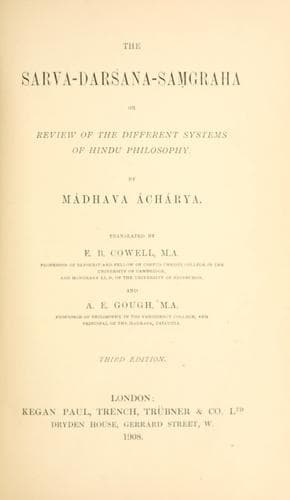
The Sarva-Darsana-Samgraha: Or, Review of the Different Systems of Hindu PhilosophyMadhava
ReligionEastern
The Sarva-Darsana-Samgraha: Or, Review of the Different Systems of Hindu Philosophy
Madhava
Philosophy, Hindu; Philosophy, Indic
The insentient, which while unconscious is dependent on the conscious,
is of two kinds, as styled the effect and as styled the cause. The
insentient, styled the effect, is of ten kinds, viz., the earth and
the other four elements, and their qualities, colour, and the rest.
The insentient, called the causal insentient, is of thirteen kinds,
viz., the five organs of cognition, the five organs of action, and the
three internal organs, intellect, the egoising principle, and the
cogitant principle, which have for their respective functions
ascertainment, the illusive identification of self with not-self, and
determination.
The sentient spirit, that to which transmigratory conditions pertain,
is also of two kinds, the appetent and non-appetent. The appetent is
the spirit associated with an organism and organs; the non-appetent is
the spirit apart from organism and organs. The details of all this are
to be found in the Pañchártha-bháshyadípiká and other works. The cause
is that which retracts into itself and evolves the whole creation.
This though one is said to be divided according to a difference of
attributes and actions (into Maheśvara, Vishṇu, &c.) The Lord is the
possessor of infinite, visual, and active power. He is absolutely
first as connected eternally with this lordship or supremacy, as
possessing a supremacy not adventitious or contingent. This is
expounded by the author of the Ádarśa, and other institutional
authorities.
Union is a conjunction of the soul with God through the intellect, and
is of two degrees, that characterised by action, and that
characterised by cessation of action. Of these, union characterised by
action consists of pious muttering, meditation, and so forth; union
characterised by cessation of action is called consciousness, &c.
Rite or ritual is activity efficacious of merit as its end. It is of
two orders, the principal and the subsidiary. Of these, the principal
is the direct means of merit, religious exercise. Religious exercise
is of two kinds, acts of piety and postures. The acts of piety are
bathing with sand, lying upon sand, oblations, mutterings, and
devotional perambulation. Thus the revered Nakulíśa says:--
"He should bathe thrice a day, he should lie upon the dust.
Oblation is an observance divided into six members."
Thus the author of the aphorisms says:--
"He should worship with the six kinds of oblations, viz.,
laughter, song, dance, muttering _hum_, adoration, and pious
ejaculation."
Public-domain text, read in full here on John Shaqi.
Reviews
Reviews
No reviews yet
Be the first to share your thoughts on this work.
Elsewhere in the archive
Join the Discussion
Join the discussion
Sign in to leave a comment or review.
Sign InorCreate an account