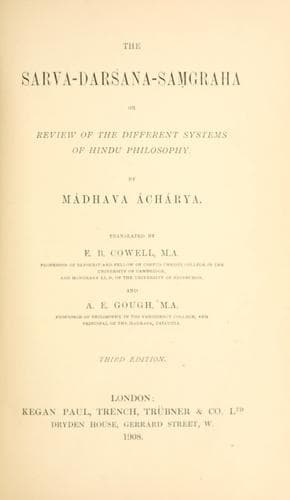
The Sarva-Darsana-Samgraha: Or, Review of the Different Systems of Hindu PhilosophyMadhava
ReligionEastern
The Sarva-Darsana-Samgraha: Or, Review of the Different Systems of Hindu Philosophy
Madhava
Philosophy, Hindu; Philosophy, Indic
In this system the cessation of pain is of two kinds, impersonal and
personal. Of these, the impersonal consists in the absolute
extirpation of all pains; the personal in supremacy consisting of the
visual and active powers. Of these two powers the visual, while only
one power, is, according to its diversity of objects, indirectly
describable as of five kinds, vision, audition, cogitation,
discrimination, and omniscience. Of these five, vision is cognition of
every kind of visual, tactual, and other sensible objects, though
imperceptible, intercepted, or remote. Audition is cognition of
principles, conversant about all articulate sounds. Cogitation is
cognition of principles, conversant about all kinds of thoughts.
Discrimination is cognition of principles conversant about the whole
system of institutes, according to the text and according to its
significance. Omniscience is cognition of principles ever arising and
pervaded by truth, relative to all matters declared or not declared,
summary or in detail, classified and specialised. Such is this
intellectual power.
The active power, though one only, is indirectly describable as of
three kinds, the possession of the swiftness of thought, the power of
assuming forms at will, and the faculty of expatiation. Of these, the
possession of the swiftness of thought is ability to act with
unsurpassable celerity. The power of assuming forms at will is the
faculty of employing at pleasure, and irrespective of the efficacy of
works, the organs similar and dissimilar of an infinity of organisms.
The faculty of expatiation is the possession of transcendent supremacy
even when such organs are not employed. Such is this active power.
All that is effected or educed, depending on something ulterior, it is
threefold, sentiency, the insentient, and the sentient. Of these,
sentiency is the attribute of the sentients. It is of two degrees
according to its nature as cognitive or incognitive. Cognitive
sentiency is dichotomised as proceeding discriminately and as
proceeding indiscriminately. The discriminate procedure, manifestable
by the instruments of knowledge, is called the cogitative. For by the
cogitant organ every sentient being is cognisant of objects in
general, discriminated or not discriminated, when irradiated by the
light which is identical with the external things. The incognitive
sentiency, again, is either characterised or not characterised by the
objects of the sentient soul.
Public-domain text, read in full here on John Shaqi.
Reviews
Reviews
No reviews yet
Be the first to share your thoughts on this work.
Elsewhere in the archive
Join the Discussion
Join the discussion
Sign in to leave a comment or review.
Sign InorCreate an account