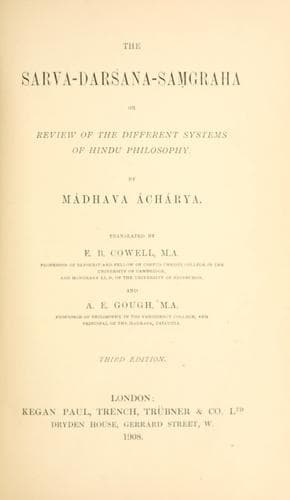
The Sarva-Darsana-Samgraha: Or, Review of the Different Systems of Hindu PhilosophyMadhava
ReligionEastern
The Sarva-Darsana-Samgraha: Or, Review of the Different Systems of Hindu Philosophy
Madhava
Philosophy, Hindu; Philosophy, Indic
(It has been stated above that omniscience, a form of the cognitive
power, is cognition of principles ever arising and pervaded by truth,
relative to all matters declared or not declared, summary, or in
detail). The summary is the enouncement of the subjects of attributes
generally. This is accomplished in the first aphorism: (Now then we
shall expound the Páśupata union and rites of Paśupati). Detail is the
fivefold enouncement of the five categories according to the
instruments of true knowledge. This is to be found in the
Ráśíkara-bháshya. Distribution is the distinct enouncement of these
categories, as far as possible according to definitions. It is an
enumeration of these according to their prevailing characters,
different from that of other recognised systems. For example, the
cessation of pain (or emancipation) is in other systems (as in the
Sānkhya) the mere termination of miseries, but in this system it is
the attainment of supremacy or of the divine perfections. In other
systems the create is that which has become, and that which shall
become, but in this system it is eternal, the spirits, and so forth,
the sentient and insentient. In other systems the _principium_ is
determined in its evolution or creative activity by the efficacy of
works, whereas in this system the _principium_ is the Lord not thus
determined. In other institutes union results in isolation, &c., while
in these institutes it results in cessation of pains by attainment of
the divine perfections. In other systems paradise and similar spheres
involve a return to metempsychosis, but in this system they result in
nearness to the Supreme Being, either followed or not followed by
such return to transmigratory experiences.
Public-domain text, read in full here on John Shaqi.
Reviews
Reviews
No reviews yet
Be the first to share your thoughts on this work.
Elsewhere in the archive
Join the Discussion
Join the discussion
Sign in to leave a comment or review.
Sign InorCreate an account