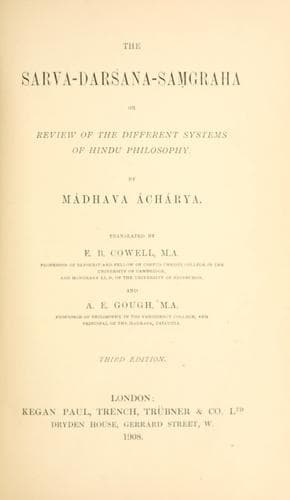
The Sarva-Darsana-Samgraha: Or, Review of the Different Systems of Hindu PhilosophyMadhava
ReligionEastern
The Sarva-Darsana-Samgraha: Or, Review of the Different Systems of Hindu Philosophy
Madhava
Philosophy, Hindu; Philosophy, Indic
Great, indeed, an opponent may say, is this aggregate of illusions,
since if God's causality be irrespective of the efficacy of works,
then merits will be fruitless, and all created things will be
simultaneously evolved (there being no reason why this should be
created at one time, and that at another), and thus there will emerge
two difficulties. Think not so, replies the Páśupata, for your
supposition is baseless. If the Lord, irrespective of the efficacy of
works, be the cause of all, and thus the efficacy of works be without
results, what follows? If you rejoin that an absence of motives will
follow, in whom, we ask, will this absence of motives follow? If the
efficacy of works be without result, will causality belong to the doer
of the works as to the Lord? It cannot belong to the doer of the
works, for it is allowed that the efficacy of works is fruitful only
when furthered by the will of the creator, and the efficacy so
furthered may sometimes be fruitless, as in the case of the works of
Yayáti, and others. From this it will by no means follow that no one
will engage in works, for they will engage in them as the husbandman
engages in husbandry, though the crop be uncertain. Again, sentient
creatures engage in works because they depend on the will of the
creator. Nor does the causality pertain to the Lord alone, for as all
his desires are already satisfied, he cannot be actuated by motives to
be realised by works. As for your statement, continues the Páśupata,
that all things will be simultaneously evolved, this is unreasonable,
inasmuch as we hold that causal efficiency resides in the unobstructed
active power which conforms itself to the will of the Lord, whose
power is inconceivable. It has accordingly been said by those versed
in sacred tradition:--
"Since he, acting according to his will, is not actuated by
the efficacy of works,
"For this reason is he in this system the cause of all
causes."
Public-domain text, read in full here on John Shaqi.
Reviews
Reviews
No reviews yet
Be the first to share your thoughts on this work.
Elsewhere in the archive
Join the Discussion
Join the discussion
Sign in to leave a comment or review.
Sign InorCreate an account