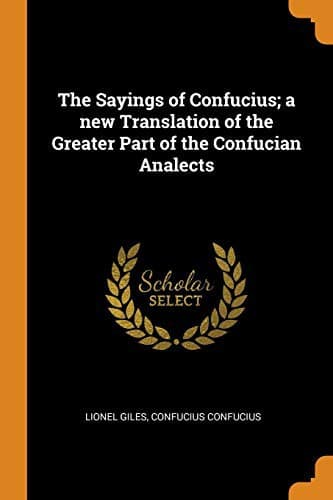
The Sayings of Confucius: A New Translation of the Greater Part of the Confucian Analects — John Shaqi
The Sayings of Confucius: A New Translation of the Greater Part of the Confucian AnalectsConfucius
ReligionEastern
The Sayings of Confucius: A New Translation of the Greater Part of the Confucian Analects
Confucius
Ethics -- China; Philosophy, Chinese
The last accusation against Confucius is the most reckless of all.
"There is," according to Mr. Jennings, "a certain _selfishness_ in
his teaching, which had the effect of making those who came under his
influence soon feel themselves great and self-satisfied." As only the
feeblest of evidence is produced to support this wild statement, it
will not be necessary to consider it at any length, though we may ask
in passing whether Yen Hui, the disciple who profited most from his
Master's teaching and best exemplified it, is depicted as exhibiting
this alleged self-satisfaction in a peculiarly noticeable degree. For
an answer to this question the reader may be referred to Tsêng Tzŭ's
remarks on p. 128.
The truth is, though missionaries and other zealots have long attempted
to obscure the fact, that the moral teaching of Confucius is absolutely
the purest and least open to the charge of selfishness of any in
the world. Its principles are neither utilitarian on the one hand
nor religious on the other, that is to say, it is not based on the
expectation of profit or happiness to be gained either in this world or
in the next (though Confucius doubtless believed that well-being would
as a general rule accompany virtuous conduct). "Virtue for virtue's
sake" is the maxim which, if not enunciated by him in so many words,
was evidently the corner-stone of his ethics and the mainspring of
his own career. Not that he would have quite understood the modern
formula, or that the idea of virtue being practised for anything but
its own sake would ever have occurred to his mind. Virtue resting on
anything but its own basis would not have seemed to him virtue in the
true sense at all, but simply another name for prudence, foresight,
or cunning. Yet material advantage, disguised as much as you will,
but still material advantage in one form or another, is what impels
most men to espouse any particular form of religion. Hence it is
nothing less than a standing miracle that Confucianism, which makes
no promise of blessings to be enjoyed in this life or the next, should
have succeeded without the adjunct of other supernatural elements than
that of ancestor-worship. Even this was accepted by Confucius as a
harmless prevailing custom rather than enjoined by him as an essential
part of his doctrine. Unlike Christianity and Mahometanism, the Way
preached by the Chinese sage knows neither the sanction of punishment
nor the stimulus of reward in an after-life. Even Buddhism holds out
the hope of Nirvana to the pure of heart, and preaches the long torment
of successive rebirths to those who fall short of perfect goodness.
No great religion is devoid of elevated precepts, or has ever failed
to mould numbers of beautiful characters to attest the presence of
something good and great within it. But in every case the element
of supernaturalism, which is of course inseparable from a religion
properly so called, introduces a new motive for men's actions and makes
Public-domain text, read in full here on John Shaqi.
Reviews
Reviews
No reviews yet
Be the first to share your thoughts on this work.
Join the Discussion
Join the discussion
Sign in to leave a comment or review.
Sign InorCreate an account