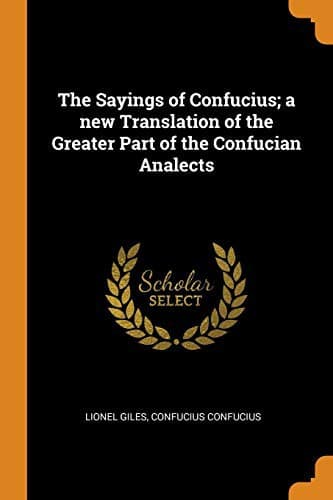
The Sayings of Confucius: A New Translation of the Greater Part of the Confucian AnalectsConfucius
ReligionEastern
The Sayings of Confucius: A New Translation of the Greater Part of the Confucian Analects
Confucius
Ethics -- China; Philosophy, Chinese
[2] _Jên_, the term here translated "virtue," is perhaps the most
important single word in the Analects, and the real corner-stone
of Confucian ethics. Its primary meaning, in accordance with the
etymology, is "humanity" in the larger sense, i.e. natural goodness
of heart as shown in intercourse with one's fellow-men. Hence it
is sometimes best translated "loving-kindness" or "charity" in the
biblical sense, though in many cases a more convenient, if vaguer,
rendering is "virtue," "moral virtue," or even, as in Legge, "perfect
virtue."
[3] Literally, "he may be called a lover of learning." But "learning"
in the mouth of Confucius is generally to be understood as study of
the rules of right conduct with a view to their practical application.
The object of all learning was to enable a man to develop the natural
goodness within him, so as to lead a life of virtuous culture. It was
not pursued solely for its own sake, nor had it become, as with us,
divorced from all ethical significance.
[4] The chief of the house of Mêng, one of the three great families of
Lu, and (according to Ssŭ-ma Ch‘ien) a disciple of Confucius.
[5] The reply is enigmatical, but it is clear from what follows that
this, and not, as Legge translates, "disobedience," is the true meaning.
[6] The eldest son of Mêng I Tzŭ.
[7] It is astonishing that Chu Hsi should have tried to improve on
the old commentators here, and almost equally astonishing that Legge
should have followed him, with this result: "The Master said, Parents
are anxious lest their children should be sick" (and therefore children
should take care of their persons)!
[8] Here again it is almost incredible that Legge should have adopted
such a ridiculous interpretation as the following--without the
authority, this time, of Chu Hsi: "The filial piety of nowadays means
the support of one's parents. But dogs and horses likewise are able
to do something in the way of support." The image conjured up by this
sentence is grotesque, to say the least.
[9] Literally, "colour difficult." This famous sentence, a
stumbling-block to native and foreigner alike, surely marks the extreme
limit to which conciseness can be carried in Chinese. "The difficulty
is with the countenance" is the lame translation offered by Legge,
and later scholars have mostly followed in his footsteps, even Mr. Ku
Hung-ming failing badly for once. Where all have gone astray is in
taking the "difficulty" to exist in the mind of the would-be filial
son, instead of being that felt by the onlooker who wishes to gauge
the genuineness of the quality in others. Only a few months ago, a new
and ingenious interpretation was suggested by my father, Professor
H. A. Giles, namely: "To define it is difficult"; but after much
consideration I am led to prefer the rendering in the text, inasmuch as
the word _sê_ is quite commonly used to denote the external as opposed
to the internal, form as opposed to essence.
Public-domain text, read in full here on John Shaqi.
Reviews
Reviews
No reviews yet
Be the first to share your thoughts on this work.
Join the Discussion
Join the discussion
Sign in to leave a comment or review.
Sign InorCreate an account