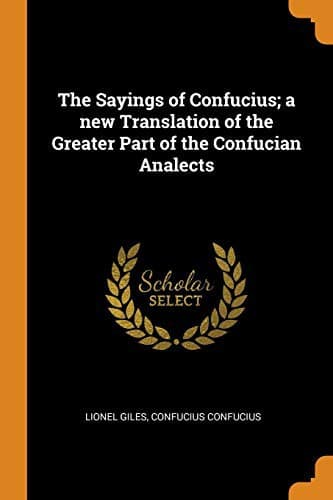
The Sayings of Confucius: A New Translation of the Greater Part of the Confucian Analects — John Shaqi
The Sayings of Confucius: A New Translation of the Greater Part of the Confucian AnalectsConfucius
ReligionEastern
The Sayings of Confucius: A New Translation of the Greater Part of the Confucian Analects
Confucius
Ethics -- China; Philosophy, Chinese
[12] This is said to be a sneer at the restlessness which kept
Confucius wandering all over the country, so that no place could be
unfamiliar to him.
[13] The idea is, "Every man to his own trade. Why should I not then
busy myself with government--the subject to which I have devoted my
life?" I do not agree with Legge that the compiler of this chapter
could not have been a disciple of the sage. Confucius successfully
refutes the _laisser-faire_ argument of the hermit, who would dissuade
him from reform on the strange and unsatisfactory ground that the
world's affairs were in a thoroughly bad state. To any one but a Taoist
it would be evident that this was the very time for reform.
[14] A leading member of one of the three great families in the Lu
State.
[15] A high official.
SAYINGS OF THE DISCIPLES
Yu Tzŭ said: It is seldom that good sons and brothers are given to
insubordinate conduct. That those who dislike insubordinate conduct
should be ready to foment sedition, is something absolutely unknown.
The wise man attends to the root; for if this be properly set, virtue
will spring from it. And what is the root of all goodness but filial
piety and fraternal love?
Tsêng Tzŭ said: There are three points on which I daily examine
myself:--Have I been conscientious in working for others? Have I been
truthful in my intercourse with my friends? Have I practised what I
preach?
Tzŭ Hsia said: The man who can appreciate moral worth and disengage
his mind from sensual passion; who can put forth his utmost strength
to serve his parents, and lay down his life to serve his prince; who
speaks sincerely in his intercourse with friends:--such a man, though
the world may call him untaught, has in my opinion received the best
and highest education.
Tzŭ Kung said: What do you say of the poor man who refuses to flatter,
and of the rich man who is free from pride?--They are well enough,
replied the Master; but better still is the poor man who is cheerful,
and the rich man who cherishes the inner principle of harmony and
self-control.--Tzŭ Kung said: One must "cut and then carve, chisel and
then polish," as the Odes have it. Does not this passage illustrate
what you say?--The Master exclaimed: Here is somebody at last with whom
I can really discuss the Odes. Refer him to any old verse, and he will
see its application.[1]
Tzŭ Hsia asked, saying: What is the meaning of the passage:
"What dimples in her witching smile!
What lovely eyes, clear white and black!
Simplicity sets off her ornaments"?
The Master replied: You must have a plain background before you can lay
on the colours.--Rules of ceremony then require a background?--Ah!
exclaimed the Master, Shang always seizes my drift. Here at any rate is
some one with whom I can discuss the Odes.[2]
Tzŭ Yu said: Too much fault-finding with princes entails disgrace; with
friends, it brings estrangement.
Public-domain text, read in full here on John Shaqi.
Reviews
Reviews
No reviews yet
Be the first to share your thoughts on this work.
Join the Discussion
Join the discussion
Sign in to leave a comment or review.
Sign InorCreate an account