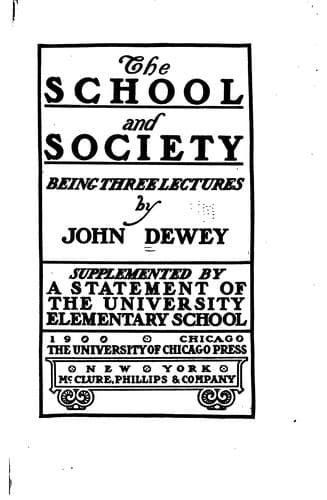
The School and Society: Being three lecturesDewey, John
Philosophy
The School and Society: Being three lectures
Dewey, John
Education; Education -- Philosophy; Educational psychology; University of Chicago. University Elementary School
The great thing to keep in mind, then, regarding the introduction into
the school of various forms of active occupation, is that through them
the entire spirit of the school is renewed. It has a chance to affiliate
itself with life, to become the child’s habitat, where he learns through
directed living; instead of being only a place to learn lessons having
an abstract and remote reference to some possible living to be done in
the future. It gets a chance to be a miniature community, an embryonic
society. This is the fundamental fact, and from this arise continuous
and orderly sources of instruction. Under the industrial _régime_
described, the child, after all, shared in the work, not for the sake of
the sharing, but for the sake of the product. The educational results
secured were real, yet incidental and dependent. But in the school the
typical occupations followed are freed from all economic stress. The aim
is not the economic value of the products, but the development of social
power and insight. It is this liberation from narrow utilities, this
openness to the possibilities of the human spirit that makes these
practical activities in the school allies of art and centers of science
and history.
The unity of all the sciences is found in geography. The significance of
geography is that it presents the earth as the enduring home of the
occupations of man. The world without its relationship to human activity
is less than a world. Human industry and achievement, apart from their
roots in the earth, are not even a sentiment, hardly a name. The earth
is the final source of all man’s food. It is his continual shelter and
protection, the raw material of all his activities, and the home to
whose humanizing and idealizing all his achievement returns. It is the
great field, the great mine, the great source of the energies of heat,
light, and electricity; the great scene of ocean, stream, mountain, and
plain, of which all our agriculture and mining and lumbering, all our
manufacturing and distributing agencies, are but the partial elements
and factors. It is through occupations determined by this environment
that mankind has made its historical and political progress. It is
through these occupations that the intellectual and emotional
interpretation of nature has been developed. It is through what we do in
and with the world that we read its meaning and measure its value.
In educational terms, this means that these occupations in the school
shall not be mere practical devices or modes of routine employment, the
gaining of better technical skill as cooks, sempstresses, or carpenters,
but active centers of scientific insight into natural materials and
processes, points of departure whence children shall be led out into a
realization of the historic development of man. The actual significance
of this can be told better through one illustration taken from actual
school work than by general discourse.
Public-domain text, read in full here on John Shaqi.
Reviews
Reviews
No reviews yet
Be the first to share your thoughts on this work.
Join the Discussion
Join the discussion
Sign in to leave a comment or review.
Sign InorCreate an account