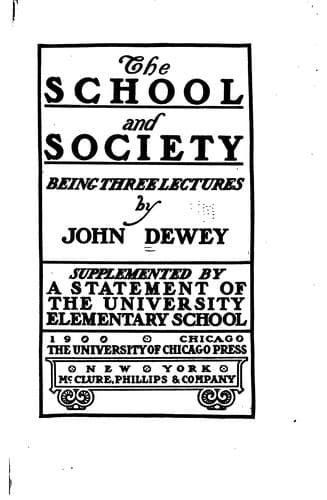
The School and Society: Being three lecturesDewey, John
Philosophy
The School and Society: Being three lectures
Dewey, John
Education; Education -- Philosophy; Educational psychology; University of Chicago. University Elementary School
While training for the profession of learning is regarded as the type of
culture, as a liberal education, that of a mechanic, a musician, a
lawyer, a doctor, a farmer, a merchant, or a railroad manager is
regarded as purely technical and professional. The result is that which
we see about us everywhere—the division into “cultured” people and
“workers,” the separation of theory and practice. Hardly one per cent.
of the entire school population ever attains to what we call higher
education; only five per cent. to the grade of our high school; while
much more than half leave on or before the completion of the fifth year
of the elementary grade. The simple facts of the case are that in the
great majority of human beings the distinctively intellectual interest
is not dominant. They have the so-called practical impulse and
disposition. In many of those in whom by nature intellectual interest is
strong, social conditions prevent its adequate realization. Consequently
by far the larger number of pupils leave school as soon as they have
acquired the rudiments of learning, as soon as they have enough of the
symbols of reading, writing, and calculating to be of practical use to
them in getting a living. While our educational leaders are talking of
culture, the development of personality, etc., as the end and aim of
education, the great majority of those who pass under the tuition of the
school regard it only as a narrowly practical tool with which to get
bread and butter enough to eke out a restricted life. If we were to
conceive our educational end and aim in a less exclusive way, if we were
to introduce into educational processes the activities which appeal to
those whose dominant interest is to do and to make, we should find the
hold of the school upon its members to be more vital, more prolonged,
containing more of culture.
Public-domain text, read in full here on John Shaqi.
Reviews
Reviews
No reviews yet
Be the first to share your thoughts on this work.
Join the Discussion
Join the discussion
Sign in to leave a comment or review.
Sign InorCreate an account