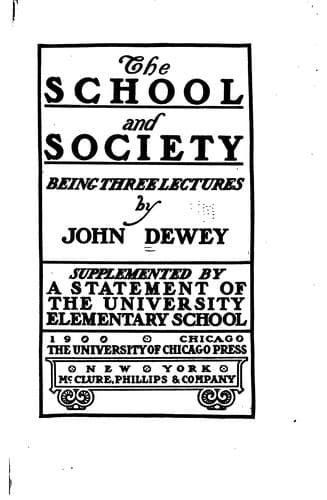
The School and Society: Being three lecturesDewey, John
Philosophy
The School and Society: Being three lectures
Dewey, John
Education; Education -- Philosophy; Educational psychology; University of Chicago. University Elementary School
Some few years ago I was looking about the school supply stores in the
city, trying to find desks and chairs which seemed thoroughly suitable
from all points of view—artistic, hygienic, and educational—to the needs
of the children. We had a good deal of difficulty in finding what we
needed, and finally one dealer, more intelligent than the rest, made
this remark: “I am afraid we have not what you want. You want something
at which the children may work; these are all for listening.” That tells
the story of the traditional education. Just as the biologist can take a
bone or two and reconstruct the whole animal, so, if we put before the
mind’s eye the ordinary schoolroom, with its rows of ugly desks placed
in geometrical order, crowded together so that there shall be as little
moving room as possible, desks almost all of the same size, with just
space enough to hold books, pencils and paper, and add a table, some
chairs, the bare walls, and possibly a few pictures, we can reconstruct
the only educational activity that can possibly go on in such a place.
It is all made “for listening”—for simply studying lessons out of a book
is only another kind of listening; it marks the dependency of one mind
upon another. The attitude of listening means, comparatively speaking,
passivity, absorption; that there are certain ready-made materials which
are there, which have been prepared by the school superintendent, the
board, the teacher, and of which the child is to take in as much as
possible in the least possible time.
There is very little place in the traditional schoolroom for the child
to work. The workshop, the laboratory, the materials, the tools with
which the child may construct, create, and actively inquire, and even
the requisite space, have been for the most part lacking. The things
that have to do with these processes have not even a definitely
recognized place in education. They are what the educational authorities
who write editorials in the daily papers generally term “fads” and
“frills.” A lady told me yesterday that she had been visiting different
schools trying to find one where activity on the part of the children
preceded the giving of information on the part of the teacher, or where
the children had some motive for demanding the information. She visited,
she said, twenty-four different schools before she found her first
instance. I may add that that was not in this city.
Another thing that is suggested by these schoolrooms, with their set
desks, is that everything is arranged for handling as large numbers of
children as possible; for dealing with children _en masse_, as an
aggregate of units; involving, again, that they be treated passively.
The moment children act they individualize themselves; they cease to be
a mass, and become the intensely distinctive beings that we are
acquainted with out of school, in the home, the family, on the
playground, and in the neighborhood.
Public-domain text, read in full here on John Shaqi.
Reviews
Reviews
No reviews yet
Be the first to share your thoughts on this work.
Join the Discussion
Join the discussion
Sign in to leave a comment or review.
Sign InorCreate an account