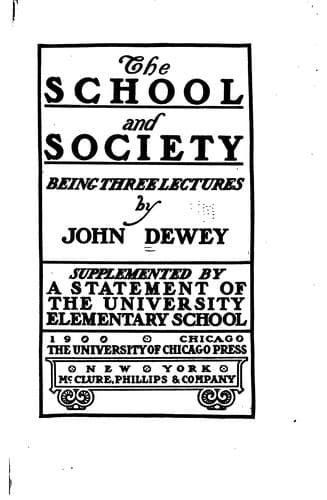
The School and Society: Being three lectures — John Shaqi
The School and Society: Being three lecturesDewey, John
Philosophy
The School and Society: Being three lectures
Dewey, John
Education; Education -- Philosophy; Educational psychology; University of Chicago. University Elementary School
Now, keeping in mind these fourfold interests—the interest in
conversation or communication; in inquiry, or finding out things; in
making things, or construction; and in artistic expression—we may say
they are the natural resources, the uninvested capital, upon the
exercise of which depends the active growth of the child. I wish to give
one or two illustrations, the first from the work of children seven
years of age. It illustrates in a way the dominant desire of the
children to talk, particularly about folks and of things in relation to
folks. If you observe little children, you will find they are interested
in the world of things mainly in its connection with people, as a
background and medium of human concerns. Many anthropologists have told
us there are certain identities in the child interests with those of
primitive life. There is a sort or natural recurrence of the child mind
to the typical activities of primitive peoples; witness the hut which
the boy likes to build in the yard, playing hunt, with bows, arrows,
spears, and so on. Again the question comes: What are we to do with this
interest—are we to ignore it, or just excite and draw it out? Or shall
we get hold of it and direct it to something ahead, something better?
Some of the work that has been planned for our seven-year-old children
has the latter end in view—to utilize this interest so that it shall
become a means of seeing the progress of the human race. The children
begin by imagining present conditions taken away until they are in
contact with nature at first hand. That takes them back to a hunting
people, to a people living in caves or trees and getting a precarious
subsistence by hunting and fishing. They imagine as far as possible the
various natural physical conditions adapted to that sort of life; say, a
hilly, woody slope, near mountains and a river where fish would be
abundant. Then they go on in imagination through the hunting to the
semi-agricultural stage, and through the nomadic to the settled
agricultural stage. The point I wish to make is that there is abundant
opportunity thus given for actual study, for inquiry which results in
gaining information. So, while the instinct primarily appeals to the
social side, the interest of the child in people and their doings is
carried on into the larger world of reality. For example, the children
had some idea of primitive weapons, of the stone arrowhead, etc. That
provided occasion for the testing of materials as regards their
friability, their shape, texture, etc., resulting in a lesson in
mineralogy, as they examined the different stones to find which was best
suited to the purpose. The discussion of the iron age supplied a demand
for the construction of a smelting oven made out of clay, and of
considerable size. As the children did not get their drafts right at
first, the mouth of the furnace not being in proper relation to the
vent, as to size and position, instruction in the principles of
Public-domain text, read in full here on John Shaqi.
Reviews
Reviews
No reviews yet
Be the first to share your thoughts on this work.
Join the Discussion
Join the discussion
Sign in to leave a comment or review.
Sign InorCreate an account