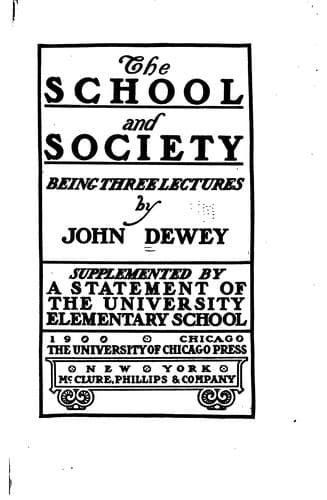
The School and Society: Being three lectures — John Shaqi
The School and Society: Being three lecturesDewey, John
Philosophy
The School and Society: Being three lectures
Dewey, John
Education; Education -- Philosophy; Educational psychology; University of Chicago. University Elementary School
This change of the recitation from an examination of knowledge already
acquired to the free play of the children’s communicative instinct,
affects and modifies all the language work of the school. Under the old
_régime_ it was unquestionably a most serious problem to give the
children a full and free use of language. The reason was obvious. The
natural motive for language was seldom offered. In the pedagogical
text-books language is defined as the medium of expressing thought. It
becomes that, more or less, to adults with trained minds, but it hardly
needs to be said that language is primarily a social thing, a means by
which we give our experiences to others and get theirs again in return.
When it is taken from its natural basis, it is no wonder that it becomes
a complex and difficult problem to teach language. Think of the
absurdity of having to teach language as a thing by itself. If there is
anything the child will do before he goes to school, it is to talk of
the things that interest him. But when there are no vital interests
appealed to in the school, when language is used simply for the
repetition of lessons, it is not surprising that one of the chief
difficulties of school work has come to be instruction in the
mother-tongue. Since the language taught is unnatural, not growing out
of the real desire to communicate vital impressions and convictions, the
freedom of children in its use gradually disappears, until finally the
high-school teacher has to invent all kinds of devices to assist in
getting any spontaneous and full use of speech. Moreover, when the
language instinct is appealed to in a social way, there is a continual
contact with reality. The result is that the child always has something
in his mind to talk about, he has something to say; he has a thought to
express, and a thought is not a thought unless it is one’s own. On the
traditional method, the child must say something that he has merely
learned. There is all the difference in the world between having
something to say and having to say something. The child who has a
variety of materials and facts wants to talk about them, and his
language becomes more refined and full, because it is controlled and
informed by realities. Reading and writing, as well as the oral use of
language, may be taught on this basis. It can be done in a _related_
way, as the outgrowth of the child’s social desire to recount his
experiences and get in return the experiences of others, directed always
through contact with the facts and forces which determine the truth
communicated.
Public-domain text, read in full here on John Shaqi.
Reviews
Reviews
No reviews yet
Be the first to share your thoughts on this work.
Join the Discussion
Join the discussion
Sign in to leave a comment or review.
Sign InorCreate an account