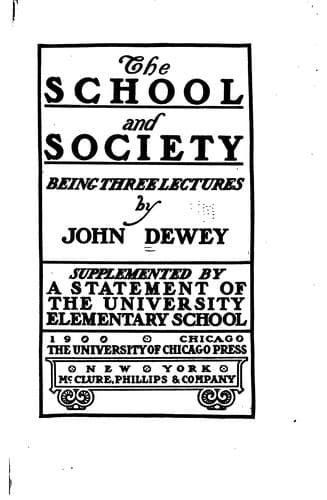
The School and Society: Being three lecturesDewey, John
Philosophy
The School and Society: Being three lectures
Dewey, John
Education; Education -- Philosophy; Educational psychology; University of Chicago. University Elementary School
But although I have selected this especial way of approach (as a
concession to the question almost universally raised), I am not willing
to leave the matter in this more or less negative and explanatory
condition. Life is the great thing after all; the life of the child at
its time and in its measure, no less than the life of the adult. Strange
would it be, indeed, if intelligent and serious attention to what the
child _now_ needs and is capable of in the way of a rich, valuable, and
expanded life should somehow conflict with the needs and possibilities
of later, adult life. “Let us live with our children,” certainly means,
first of all, that our children shall live—not that they shall be
hampered and stunted by being forced into all kinds of conditions, the
most remote consideration of which is relevancy to the present life of
the child. If we seek the kingdom of heaven, educationally, all other
things shall be added unto us—which, being interpreted, is that if we
identify ourselves with the real instincts and needs of childhood, and
ask only after its fullest assertion and growth, the discipline and
information and culture of adult life shall all come in their due
season.
Speaking of culture reminds me that in a way I have been speaking only
of the outside of the child’s activity—only of the outward expression of
his impulses toward saying, making, finding out, and creating. The real
child, it hardly need be said, lives in the world of imaginative values,
and ideas which find only imperfect outward embodiment. We hear much
nowadays about the cultivation of the child’s “imagination.” Then we
undo much of our own talk and work by a belief that the imagination is
some special part of the child, that finds its satisfaction in some one
particular direction—generally speaking, that of the unreal and
make-believe, of the myth and made-up story. Why are we so hard of heart
and so slow to believe? The imagination is the medium in which the child
lives. To him there is everywhere and in everything that occupies his
mind and activity at all, a surplusage of value and significance. The
question of the relation of the school to the child’s life is at bottom
simply this: shall we ignore this native setting and tendency, dealing
not with the living child at all, but with the dead image we have
erected, or shall we give it play and satisfaction? If we once believe
in life and in the life of the child, then will all the occupations and
uses spoken of, then will all history and science, become instruments of
appeal and materials of culture to his imagination, and through that to
the richness and the orderliness of his life. Where we now see only the
outward doing and the outward product, there, behind all visible
results, is the re-adjustment of mental attitude, the enlarged and
sympathetic vision, the sense of growing power, and the willing ability
to identify both insight and capacity with the interests of the world
and man.
Public-domain text, read in full here on John Shaqi.
Reviews
Reviews
No reviews yet
Be the first to share your thoughts on this work.
Join the Discussion
Join the discussion
Sign in to leave a comment or review.
Sign InorCreate an account