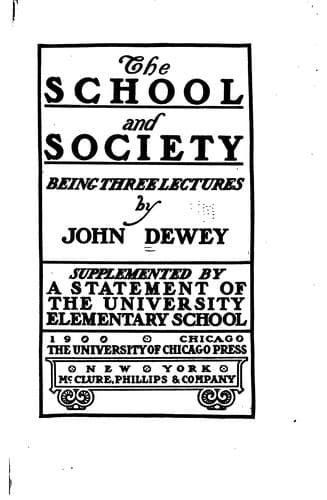
The School and Society: Being three lectures — John Shaqi
The School and Society: Being three lecturesDewey, John
Philosophy
The School and Society: Being three lectures
Dewey, John
Education; Education -- Philosophy; Educational psychology; University of Chicago. University Elementary School
The school system, upon the whole, has grown from the top down. During
the middle ages it was essentially a cluster of professional
schools—especially law and theology. Our present university comes down
to us from the middle ages. I will not say that at present it is a
mediæval institution, but it had its roots in the middle ages, and it
has not outlived all mediæval traditions regarding learning.
The kindergarten, rising with the present century, was a union of the
nursery and of the philosophy of Schelling; a wedding of the plays and
games which the mother carried on with her children, to Schelling’s
highly romantic and symbolic philosophy. The elements that came from the
actual study of child life—the continuation of the nursery—have remained
a life-bringing force in all education; the Schellingesque factors made
an obstruction between it and the rest of the school system, brought
about isolations.
The line drawn over the top indicates that there is a certain
interaction between the kindergarten and the primary school; for, so far
as the primary school remained in spirit foreign to the natural
interests of child life, it was isolated from the kindergarten, so that
it is a problem, at present, to introduce kindergarten methods into the
primary school; the problem of the so-called connecting class. The
difficulty is that the two are not one from the start. To get a
connection the teacher has had to climb over the wall instead of
entering in at the gate.
On the side of aims, the ideal of the kindergarten was the moral
development of the children, rather than instruction or discipline; an
ideal sometimes emphasized to the point of sentimentality. The primary
school grew practically out of the popular movement of the sixteenth
century, when along with the invention of printing and the growth of
commerce, it became a business necessity to know how to read, write, and
figure. The aim was distinctly a practical one; it was utility; getting
command of these tools, the symbols of learning, not for the sake of
learning, but because they gave access to careers in life otherwise
closed.
Public-domain text, read in full here on John Shaqi.
Reviews
Reviews
No reviews yet
Be the first to share your thoughts on this work.
Join the Discussion
Join the discussion
Sign in to leave a comment or review.
Sign InorCreate an account