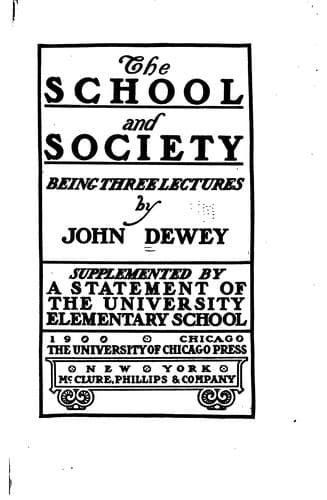
The School and Society: Being three lecturesDewey, John
Philosophy
The School and Society: Being three lectures
Dewey, John
Education; Education -- Philosophy; Educational psychology; University of Chicago. University Elementary School
Consider the training schools for teachers—the normal schools. These
occupy at present a somewhat anomalous position, intermediate between
the high school and the college, requiring the high-school preparation,
and covering a certain amount of college work. They are isolated from
the higher subject-matter of scholarship, since, upon the whole, their
object has been to train persons _how_ to teach, rather than _what_ to
teach; while, if we go to the college, we find the other half of this
isolation—learning _what_ to teach, with almost a contempt for methods
of teaching. The college is shut off from contact with children and
youth. Its members, to a great extent, away from home and forgetting
their own childhood, become eventually teachers with a large amount of
subject-matter at command, and little knowledge of how this is related
to the minds of those to whom it is to be taught. In this division
between what to teach and how to teach, each side suffers from the
separation.
It is interesting to follow out the inter-relation between primary,
grammar, and high schools. The elementary school has crowded up and
taken many subjects previously studied in the old New England grammar
school. The high school has pushed its subjects down. Latin and algebra
have been put in the upper grades, so that the seventh and eighth grades
are, after all, about all that is left of the old grammar school. They
are a sort of amorphous composite, being partly a place where children
go on learning what they already have learned (to read, write, and
figure), and partly a place of preparation for the high school. The name
in some parts of New England for these upper grades was “Intermediate
School.” The term was a happy one; the work was simply intermediate
between something that had been and something that was going to be,
having no special meaning on its own account.
Public-domain text, read in full here on John Shaqi.
Reviews
Reviews
No reviews yet
Be the first to share your thoughts on this work.
Join the Discussion
Join the discussion
Sign in to leave a comment or review.
Sign InorCreate an account