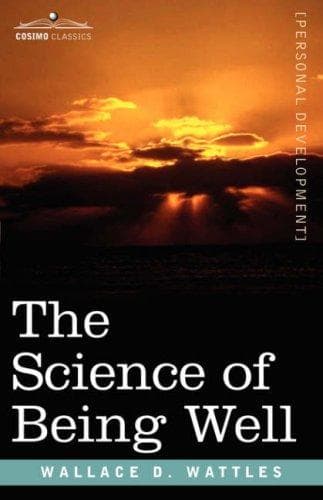
The Science of Being WellWattles, W. D. (Wallace Delois)
Science
The Science of Being Well
Wattles, W. D. (Wallace Delois)
Health; Mental healing; New Thought
In ninety-nine cases out of a hundred twelve o'clock, noon, is early
enough; and it is generally the most convenient time. If you are doing
heavy work, you will get by noon a hunger sufficient to justify a
good-sized meal; and if your work is light, you will probably still have
hunger enough for a moderate meal. The best general rule or law that can
be laid down is that you should eat your first meal of the day at noon,
if you are hungry; and if you are not hungry, wait until you become so.
And when shall I eat my second meal?
Not at all, unless you are hungry for it; and that with a genuine earned
hunger. If you do get hungry for a second meal, eat at the most
convenient time; but do not eat until you have a really earned hunger.
The reader who wishes to fully inform himself as to the reasons for this
way of arranging the mealtimes will find the best books thereon cited in
the preface to this work. From the foregoing, however, you can easily
see that the Science of Being Well readily answers the question: When,
and how often shall I eat? The answer is: Eat when you have an earned
hunger; and never eat at any other time.
CHAPTER X.
WHAT TO EAT.
The current sciences of medicine and hygiene have made no progress
toward answering the question, What shall I eat? The contests between
the vegetarians and the meat eaters, the cooked food advocates, raw food
advocates, and various other "schools" of theorists, seem to be
interminable; and from the mountains of evidence and argument piled up
for and against each special theory, it is plain that if we depend on
these scientists we shall never know what is the natural food of man.
Turning away from the whole controversy, then, we will ask the question
of nature herself, and we shall find that she has not left us without an
answer.
Most of the errors of dietary scientists grow out of a false premise as
to the natural state of man. It is assumed that civilization and mental
development are unnatural things; that the man who lives in a modern
house, in city or country, and who works in modern trade or industry for
his living is leading an unnatural life, and is in an unnatural
environment; that the only "natural" man is a naked savage, and that the
farther we get from the savage the farther we are from nature. This is
wrong. The man who has all that art and science can give him is leading
the most natural life, because he is living most completely in all his
faculties. The dweller in a well-appointed city flat, with modern
conveniences and good ventilation, is living a far more naturally human
life than the Australian savage who lives in a hollow tree or a hole in
the ground.
Public-domain text, read in full here on John Shaqi.
Reviews
Reviews
No reviews yet
Be the first to share your thoughts on this work.
Join the Discussion
Join the discussion
Sign in to leave a comment or review.
Sign InorCreate an account