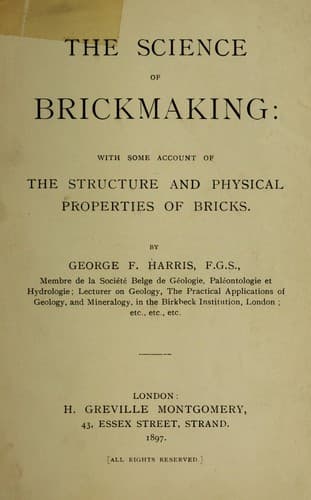
The Science of BrickmakingHarris, George Frederick
Science
The Science of Brickmaking
Harris, George Frederick
Brickmaking -- Handbooks, manuals, etc.
The abrasion test may also be made by putting the weighed bricks on
a grinding table covered with sand and water, and noting the weight
before and after grinding. This last method seems to us to be decidedly
the best, provided the bricks be weighted, that the weight is constant,
that the feed of sand and water is uniform, and that the bricks to be
tested are placed equidistant from the centre of the turning table. If
this last point be not attended to, it will be obvious that in course
of the revolutions the sand will tend to accumulate towards the centre
of the table, and the bricks placed in that vicinity would receive
more than their fair share of abrasion, as compared with those bricks
situated near the edge of the table. Conversely, those bricks near
the periphery would be subjected to greater grinding action, from the
circumstance that the table would move faster underneath them than
under those bricks nearer the centre of the table.
The bricks should certainly be weighted in such abrasion tests, and
it seems desirable that the weights should be so adjusted that the
weight of the brick is also taken into account. It is obvious that the
abrading action of, say, street traffic, will be the same on a brick,
no matter what the latter weighs, depending on the area of surface
exposed to traffic. And if we experiment with one brick, weighing say 7
lbs., and another weighing 14 lbs., the greater weight of the latter,
will (_cæteris paribus_), by the abrasion tests as usually adopted,
give a much higher result than would the lighter brick. On the other
hand, if the 7 lbs. brick be weighted another 7 lbs., then the results
would be strictly comparable, provided always that the area exposed to
abrasion in each case be the same, and that the other conditions we
have laid down are strictly observed.
Knowing as we do that the rough and ready method of “rattling” cannot
possibly give truly comparative results, we do not intend to enlarge
much on the results of the American tests; but the following are
suggestive as shewing the connexion between the tests for absorption,
rattling, and strength combined.
Some valuable and interesting tests were recently made by the Ohio
Geological Survey, to determine the relative merits of fire-clays and
shales for the manufacture of paving bricks, as well as the influence,
if any, of the method of manufacture adopted. Twenty-two varieties of
shale bricks, or bricks the largest constituent of which is shale, were
grouped together: fifteen varieties of fire-clay brick; four varieties
composed of shale and fire-clay mixed in equal proportion; and three
varieties made from Ohio River sedimentary clays. The averages of these
four classes of results were as follow:--
Public-domain text, read in full here on John Shaqi.
Reviews
Reviews
No reviews yet
Be the first to share your thoughts on this work.
Elsewhere in the archive
Join the Discussion
Join the discussion
Sign in to leave a comment or review.
Sign InorCreate an account