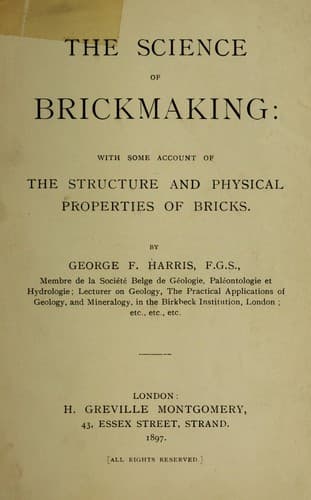
The Science of BrickmakingHarris, George Frederick
Science
The Science of Brickmaking
Harris, George Frederick
Brickmaking -- Handbooks, manuals, etc.
--------------------------------------------------
TESTS OF FIRE-CLAY AND SHALES.--PAVING BRICKS.
----------+-----------+---------+-----------------
|Absorption.|Rattling.| Crushing.
+-----------+---------+--------+--------
| | |Square | Cubic
| | |Inches. | Inches.
| | +--------+--------
Shales | 1.17 | 17.61 | 7,307 | 1,764
Fire-clay | 1.62 | 17.32 | 6,876 | 1,678
Mixture | 1.44 | 18.72 | 5,788 | 1,400
River Clay| 1.36 | 19.02 | 4,605 | 1,176
----------+-----------+---------+--------+--------
From a series of tests recently made by Mr. Fickes,[22] the following
factors were educed:--
1. A brick which stands the “rattling” test well, has ample crushing
strength and rarely chips under less than 5,000 lbs. per square inch,
or crushes under less than 10,000 lbs. The crushing strength tends to
vary with the resistance to abrasion, however, but more slowly and
irregularly.
2. The transverse strength also tends to vary with the resistance to
abrasion, but more slowly and irregularly.
3. The toughest bricks usually absorb the least water.
_Specific Gravity._--The practical value of knowing the specific
gravity of a brick has, perhaps, been a little over-rated by writers on
the subject. At the same time we do not deny that there is some use in
ascertaining this property. Foremost, we have to mention its value in
conjunction with absorption in arriving at a rough and ready means of
gauging the strength of a brick, without having actual recourse to the
crushing machine. It appears to us, however, that the specific gravity
of bricks is rarely quoted in a proper manner, and until there is one
uniform method, the results will always be at a discount. We allude to
the fact that some experimenters take the specific gravity of a porous
brick, without stating whether the amount of water absorbed, during the
process, was taken into account in arriving at the specific gravity
or not. Theoretically, of course, the substance to be dealt with is
non-porous, and experimenters, worthy the name, either render the
brick waterproof, or, ascertaining the amount of water the brick has
absorbed, take that into consideration in calculating results.
The writer is in the habit of quoting the specific gravity in two ways,
viz.: (_a_) the true specific gravity, and (_b_) the specific gravity
of the particles. In an elementary treatise like the present, however,
it is not desirable to enlarge on this subject.
THE END.
FOOTNOTES
[1] This, and all other technical terms used, will be explained in an
alphabetical glossary at the end of the book.
[2] “Canal and River Engineering,” p. 315.
[3] See, Geikie’s “Text Book of Geology,” 1882, p. 72.
[4] Information on this subject will be found in Mr. J. H. Collins’
work, “The Hensbarrow Granite District.” Truro, 1878.
Public-domain text, read in full here on John Shaqi.
Reviews
Reviews
No reviews yet
Be the first to share your thoughts on this work.
Elsewhere in the archive
Join the Discussion
Join the discussion
Sign in to leave a comment or review.
Sign InorCreate an account