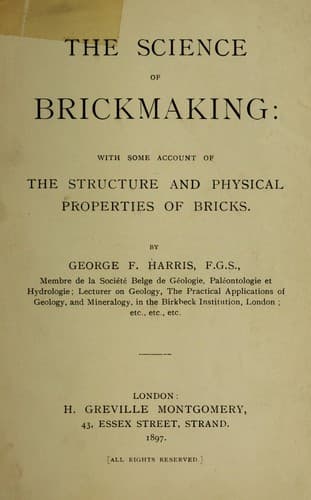
The Science of BrickmakingHarris, George Frederick
Science
The Science of Brickmaking
Harris, George Frederick
Brickmaking -- Handbooks, manuals, etc.
Take samples of brick-earth of fluviatile origin at intervals and
analyse them; no two analyses will be alike, except by a most
remarkable coincidence--more by accident than otherwise. On the other
hand, take a thick marine clay, and compare its chemical composition
as ascertained at the present time with that of it made, say, 20 years
ago in the same brickyard, and the analyses will, in most instances, be
practically identical--at any rate, so far as they may be of use to the
brickmaker.
A brickmaker using a marine clay possesses innumerable advantages over
another employing brick-earths due to river action. It is no uncommon
thing for a marine clay--say, 300 feet in thickness--to continue
across country for hundreds of miles, stretching from the North of
England to the South, and over into the Continent, save for the slight
break occasioned by the scooping out of the English Channel. The
composition of the Oxford Clay, from which the well-known bricks at
Peterborough are made, does not differ in the slightest degree, so far
as suitability for brickmaking is concerned, from the Oxford Clay of
Bourges or Chateauroux, in the centre of France, or indeed at almost
any other point _en route_. With marine beds it is possible to deal
with the matter on broad lines, but it is not so with any other class
of deposits.
If a marine clay in a specified locality is found to be unsuitable for
bricks at one point, by reason of the presence of too much lime, it
would be a phenomenon if clay along the same geological horizon did
not present the same unfavourable features at every other point within
the district. The homogeneous composition, both from mineralogical and
chemical standpoints, of thick marine clays renders them of special use
to the brickmaker. Having by sundry processes, after infinite labour,
produced a certain class of brick from such an earth, he does not as a
rule have to materially modify those processes as the earth is dug into
to continue manufacturing the same brick. He is dealing with an earth
which, comparatively speaking, is a constant quantity--when the clays
are thick, and no lines of bedding are distinctly visible.
Public-domain text, read in full here on John Shaqi.
Reviews
Reviews
No reviews yet
Be the first to share your thoughts on this work.
Join the Discussion
Join the discussion
Sign in to leave a comment or review.
Sign InorCreate an account