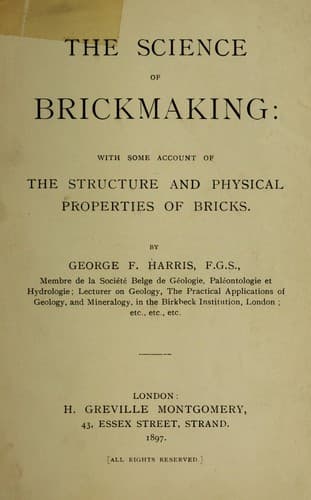
The Science of BrickmakingHarris, George Frederick
Science
The Science of Brickmaking
Harris, George Frederick
Brickmaking -- Handbooks, manuals, etc.
in the brick-earths are of extinct species--there are no species
included in this latter category of precisely similar kinds to animals
now living, Thus the elephant was different to modern elephants; we
know, from remains found elsewhere, that it was clothed with wool. The
same also with the rhinoceros. The reindeer no longer lives in this
country, being confined to northerly latitudes; whilst the musk sheep
is a denizen of the Arctic regions, and the hippopotamus is restricted
to the tropical or sub-tropical climes. But we might continue for a
long time expatiating on the character of the very numerous mammalian
remains found in our common brick-earths. What a curious assemblage of
animals! It is wonderful to contemplate the time when the reindeer and
musk sheep lived side by side with the elephant and rhinoceros on the
site whereon London now stands.
That is not all, however. In the same brick-earths and gravels, tools
(flint implements), fashioned by the hands of man, are also frequently
discovered, and in one place at Crayford, the spot whereon flint
implements were manufactured has been ’lighted upon. Each flake chipped
off has been collected and pieced together, and the shape of the
original flint has thus been determined. Clearly, from this evidence,
the earth from which millions of bricks have been made has formed
since primæval man (and with him the animals alluded to) inhabited
the valleys of the Thames and its tributaries. It is interesting, too,
to reflect on the circumstance that the materials upon which many of
these facts of great philosophical significance are based, have been
collected through the instrumentality of the workmen. Palæontologists
are proud to acknowledge that; their debt of gratitude to the
intelligent and persevering men can never be fully repaid.
Pursuing the matter still further, we discover a quantity of shells,
blanched and very frail--they seem to be deprived of much of their
original substance, so to speak; their entombment in the brick-earth
has taken all the natural colour out of them. Studying these, we soon
ascertain that they belong to land snails and mollusca which inhabit
fresh water. Living representatives of the same species are, with few
exceptions, found in Kent and Essex.
Public-domain text, read in full here on John Shaqi.
Reviews
Reviews
No reviews yet
Be the first to share your thoughts on this work.
Join the Discussion
Join the discussion
Sign in to leave a comment or review.
Sign InorCreate an account