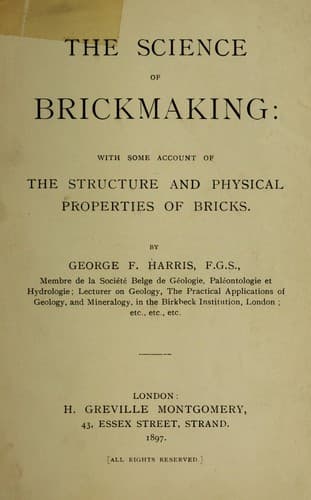
The Science of BrickmakingHarris, George Frederick
Science
The Science of Brickmaking
Harris, George Frederick
Brickmaking -- Handbooks, manuals, etc.
Here we have two clays with the carbonates of lime and magnesia
present, in one case of over 35 per cent., and in the other of over
26 per cent. Professor Lunge, of Zurich, states that the bricks made
from them, if burned at the ordinary heat, say a moderate red heat, are
_red_, and do not keep in the air, but crumble away very soon, as the
quicklime slackens on combining with the moisture. When burned at a
bright red heat, about 200° C. above the former, however, they become
nearly white. The lime is then present as a ferri-alumina-calcic
silicate, which causes the red colour of the iron oxide to disappear,
and, at the same time, entirely prevents any action of the moisture,
quicklime being no longer present. We have no hesitation whatever in
saying that most British makers would look down upon raw earths such
as these from Zurich, and yet many millions of really good bricks
have been made from them during the past twenty years, and they are
especially noted for their durability. The crux of the case is the
temperature at which the earths are burned, as the reader has perceived.
Under the heading of “magnesia,” we have said a few words regarding
basic bricks. In this country they have been made primarily from
magnesian limestone, the chemical composition of which is shown in the
following results of analyses:--
_Chemical Composition of Magnesian Limestones._
----------------------+------+-------+------+-------
| 1 | 2 | 3 | 4
----------------------+------+-------+------+-------
Silica | 3.6 | 2.53 | .8 | --
Carbonate of lime | 51.1 | 54.19 | 57.5 | 55.7
„ „ magnesia | 40.2 | 41.37 | 39.4 | 41.6
Iron, alumina | 1.8 | .30 | .7 | .4
Water, &c. | 3.3 | 1.61 | 1.6 | 2.3
----------------------+------+-------+------+-------
_Analysis No. 1_ refers to the well-known magnesian limestone of
Bolsover.
_Analysis No. 2_ to that from Huddlestone.
_Analysis No. 3_ to that from Roach Abbey.
_Analysis No. 4_ to that from Park Nook.
These results were obtained by Professors Daniell and Wheatstone in
connexion with an enquiry many years ago as to the kind of stone
suitable for the erection of the Houses of Parliament.
Public-domain text, read in full here on John Shaqi.
Reviews
Reviews
No reviews yet
Be the first to share your thoughts on this work.
Join the Discussion
Join the discussion
Sign in to leave a comment or review.
Sign InorCreate an account