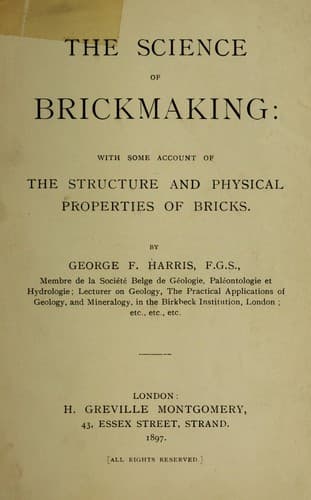
The Science of BrickmakingHarris, George Frederick
Science
The Science of Brickmaking
Harris, George Frederick
Brickmaking -- Handbooks, manuals, etc.
Whilst speaking of the various acids which attack and destroy bricks,
we must not forget those formed by the decomposition of organic matter
on the surface of bricks which “vegetate.” The lichens, mosses,
and so forth, growing from cracks in the wall, or spread over on
to the brick from the mortar, yield, on decomposition, some of the
most powerful acids in existence. A brick with a “crumbly” surface
affords good foothold for these plants, and when they die they give
rise to the so-called humus acids--crenic and apocrenic acid--which
undoubtedly do an immense amount of damage. By keeping the surface
of the brick moist, the plants permit the ordinary acids in rain to
do more execution than they otherwise would. Taking two bricks, one
which “vegetates” and one that does not, and exposing them in the same
situation, it will be found that after a smart shower of rain the
surface of the former has become thoroughly soaked, and the vegetation
keeps it so, completely rotting it in time; whereas the surface of the
latter, exposed to the same shower, may be quite dry within an hour or
two after the rain has fallen.
Returning to the subject of rainfall, which exercises such material
influence on the durability of bricks, we may give a few particulars
concerning the distribution of rain in this country. Speaking
generally, the east coast of England is the driest part of the country,
the west coast having the greatest rainfall. The annual quantity at
sea-level ranges from 60 to 80 inches on the west coasts of Ireland and
Scotland, to about 20 inches on the east coast of England.[10] In some
localities, however, the fall is much greater, amounting to 154 inches
on the average of six years at Seathwaite, in Borrowdale, at the height
of 422 feet above the sea.
The quantities which fall in particular showers are often very great,
and this aspect of rainfall also has its interest for us. About London
a fall exceeding an inch in 24 hours is comparatively rare, although
on August 1, 1846, 3.12 inches were collected in St. Paul’s Churchyard
in two hours and seventeen minutes.[11] On our west coasts this amount
is often exceeded. On October 24, 1849, 4.37 inches were collected at
Wastdale Head; June 30, 1881, 4.80 inches at Seathwaite; on April 13,
1878, 4.6 inches fell at Haverstock Hill, London; and a fall of 5.36
inches was recorded from Monmouthshire on the 14th July, 1875.
Taking averages of districts, we may give the following statistics,
referring, of course, to annual rainfall:--
Public-domain text, read in full here on John Shaqi.
Reviews
Reviews
No reviews yet
Be the first to share your thoughts on this work.
Elsewhere in the archive
Join the Discussion
Join the discussion
Sign in to leave a comment or review.
Sign InorCreate an account