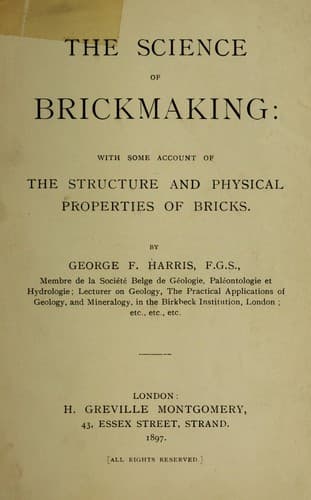
The Science of BrickmakingHarris, George Frederick
Science
The Science of Brickmaking
Harris, George Frederick
Brickmaking -- Handbooks, manuals, etc.
Less than 25 inches = Essex, Suffolk, Norfolk, Cambridgeshire,
Huntingdonshire, Rutland, Middlesex, and parts of Surrey, Oxfordshire,
Buckinghamshire, Bedfordshire, Northamptonshire, Leicestershire,
Nottinghamshire, Lincolnshire, Yorkshire, and Durham. In other words,
with the exception of parts of the North and East Ridings of Yorkshire
and parts of Herts. and Bucks., which have a rainfall of from 25 to 30
inches, the eastern half of England, to the east of a line drawn from
Sunderland to Reading, and then eastwards to the mouth of the Thames,
has only a rainfall of 25 inches, or slightly less, per annum.
Between 30 and 40 inches = Practically the whole of the south coast
from Kent to Devonshire, the whole of Somerset, Wilts., and the west of
England generally, with the exceptions about to be noticed.
Between 40 and 50 inches = A great part of Devon and Cornwall, the
western half of Wales, with the exceptions presently to be given, a
great part of Lancs., and Cumberland.
Between 50 and 75 inches = A small patch in the centre of Devon,
a large strip in West Wales, and an enormous tract of country in
Cumberland, Westmorland, with Lancs. and north-west Yorks.
Above 75 inches = The wettest parts of the country. A small part of
Dartmoor, a region in Wales in the vicinity and to the south-east of
Snowdon, and the Lake District.
With reference to statistics concerning rainfall, it should be borne
in mind that those relating to special districts, especially to hilly
parts of the country, are often very deceptive, and require careful
local study. A slight difference in the physical features of a locality
is often sufficient to lead to considerable variation--the proximity
of a conical hill rising from the plain, the sudden convergence of the
two sides of a valley, or, conversely, the widening of a valley into a
flat stretch of land, all materially affect the local distribution of
rain. A clump of trees situated in proximity to a house will frequently
be the means of a downpour that would otherwise have passed over.
With winding valleys great latitude must be allowed. Then, again,
the geological structure of the locality is an important factor in
determining the amount of moisture delivered at a given spot. Where we
find a thick clay cropping out in the bottom of a valley, with more
or less porous rocks rising on either side of it, we soon ascertain
that the houses on the clay receive more moisture (or the latter is
distributed over a longer period) than those edifices on the hill sides
in the same district.
Public-domain text, read in full here on John Shaqi.
Reviews
Reviews
No reviews yet
Be the first to share your thoughts on this work.
Elsewhere in the archive
Join the Discussion
Join the discussion
Sign in to leave a comment or review.
Sign InorCreate an account