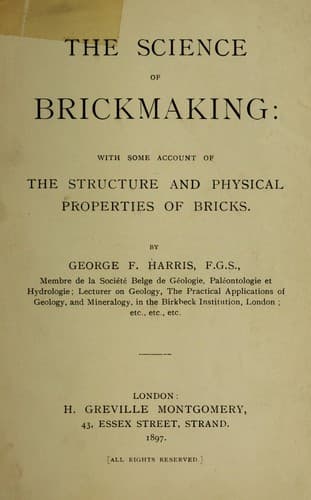
The Science of BrickmakingHarris, George Frederick
Science
The Science of Brickmaking
Harris, George Frederick
Brickmaking -- Handbooks, manuals, etc.
Our readers could no doubt give us plenty of instances where in a
circumscribed area their bricks have behaved very erratically--the
bricks of a house in one part of the district weathering well, and
in another badly. That may often be due, not only to the actual
distribution of the rain, but to the manner in which the rain or dew
has fallen. If an inch of rain falls in the neighbourhood in one day,
that would not tend to weather the bricks so vigorously as though the
fall had been spread over, say, a week.
A very important aspect of the subject is that which deals with the
“efflorescence” on bricks. This appears to be greatly misunderstood,
being commonly assumed to be due to one set of circumstances
rather than to the conspiracy of several. There are many kinds of
efflorescence, and an explanation of one of them obviously will not
apply to all. The “scum” that appears on the surface of bricks is,
however, to some extent bound up in the composition of the rain in the
particular locality where it occurs. Examined attentively, the commoner
kinds of efflorescence are seen to be minute white and yellowish-white
crystals. The substance of which these are formed has been drawn out
of the brick, or the mortar, or both, and rain has been the principal
agent in accomplishing this work, though its power in that respect must
necessarily vary according to the chemical composition and structure
of the brick or mortar, as compared with the nature of impurities in
the rain. If some substance were present in the rain that could readily
form an alliance with an ingredient of the brick, and the union was
capable of crystallising out, the surface of the brick would naturally
form a convenient spot for the crystallisation to take place. To
prevent it, we ought to know the composition of the air at the spot
where the house is to be erected, and also the chemical and physical
structure of the brick to be employed. That is rather too much to
expect from the manufacturer and architect; but there is a method--we
will not say an infallible one--which may be adopted to get rid of that
particular kind of scum. That method could not always be adopted, as
will be seen. The bricks must be burned more thoroughly, and at a high
temperature; that would lead in most cases to the active employment of
practically all the ingredients of which the bricks are composed, and
the impurities in the rain would, in consequence, stand less chance
of successfully inducing some of them to break their allegiance.
In practice, however, we believe it would be found that the high
temperature requisite to bring about the result just stated would
either tend to spoil the colour of the brick or partially melt it. The
latter could be prevented with due care, but we are afraid the former
could not be so easily dealt with, with the majority of brick-earths.
And if the brick is to be permanently discoloured to prevent
efflorescence, it is better to permit the latter to manifest itself.
Public-domain text, read in full here on John Shaqi.
Reviews
Reviews
No reviews yet
Be the first to share your thoughts on this work.
Elsewhere in the archive
Join the Discussion
Join the discussion
Sign in to leave a comment or review.
Sign InorCreate an account