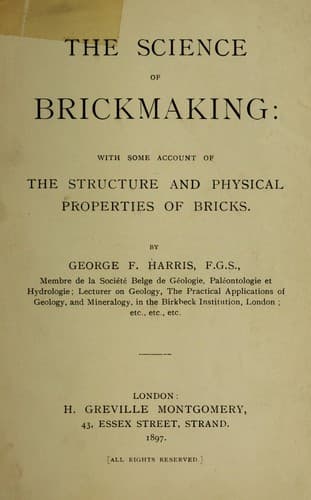
The Science of BrickmakingHarris, George Frederick
Science
The Science of Brickmaking
Harris, George Frederick
Brickmaking -- Handbooks, manuals, etc.
The life of the “scum” is very variable; sometimes, after having once
appeared and disappeared, it will never come again. The passing shower
may wash it off (though it is not always so easily removed), and it may
come again and again for years. It behaves very erratically. The amount
of the efflorescence may be such as, in course of time, to lead to the
surface of the brick “bursting” and peeling off, or, on the other hand,
it may be a mere film.
There is one thing in connexion with efflorescence which cannot be
overlooked in regarding its practical effects in the building. In ever
so many cases we find that the scum, or the major part of it, is only
to be found in the neighbourhood of the mortar joints. That is a matter
of direct observation, and we have taken some considerable trouble to
verify it, as it has always been regarded as a point whereon to hinge
a debate. We do not say that in all cases the efflorescence appears
only in the position on the brick just indicated; but it unquestionably
does so in too many instances to enable us to regard its occurrence as
mere accident. Taking a large surface of brickwork just commencing to
show efflorescence, we find that the vicinity of the mortar joints are
the first places, in very many instances, where the nuisance begins to
manifest itself. From thence it spreads over the surface of the brick
until the whole is more or less discoloured.
It seems impossible to deny that the mortar is guilty, to some extent,
in such cases. At the same time, we must confess that we have never
seen the efflorescence spreading over the mortar. It would appear that
something in the mortar enters into chemical alliance with certain
ingredients of the brick, and that neither without the other could
produce the phenomenon alluded to. The remedy suggesting itself most
readily is to chemically analyse the efflorescence, the brick, and the
mortar; supplementing the experiments with a micro-examination to see
how far it is possible to locate the deleterious substances found to
exist, so that they may be removed in the manufacture of the materials,
if that is possible. But information on that head is of the scantiest
description, and much more will have to be done before the question is
definitely settled.
Another kind of “efflorescence” that often appears on bricks in
damp situations is mere vegetable growth, which bears a superficial
resemblance to the crystalline “scum” just described, though it can,
of course, be easily differentiated on examination with a lens. The
damp atmosphere is no doubt largely responsible for this, though
ineffectual damp-courses are contributors. The remedy lies in having a
less absorbent brick--one that will not afford ready foothold to the
vegetation.
Public-domain text, read in full here on John Shaqi.
Reviews
Reviews
No reviews yet
Be the first to share your thoughts on this work.
Elsewhere in the archive
Join the Discussion
Join the discussion
Sign in to leave a comment or review.
Sign InorCreate an account