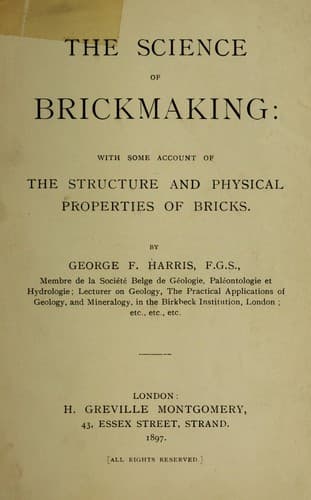
The Science of BrickmakingHarris, George Frederick
Science
The Science of Brickmaking
Harris, George Frederick
Brickmaking -- Handbooks, manuals, etc.
The influence of rain on the weathering of bricks may be considered
from yet another standpoint. Where the brick is fairly porous, its
durability is liable to be materially influenced through the agency
of successive frosts. The water finds its way a short distance into
the brick and saturates it. During frost the water is turned into ice
at and near the surface of the brick. In forming, the ice exerts
considerable expansive force, which forces asunder the particles
(sand-grains and the like) of which the brick is composed--that is
to say, near the surface of the brick. The accumulated effects of
successive frosts in this way tends to weather the brick by breaking
up its exposed surfaces. To be materially affected, however, the brick
would have to be of very poor quality, and it will be seen that the
presence of cracks would much facilitate the operation.
The style of a building, the manner of its construction, and especially
the class of metals used for exterior decoration, all assist rain in
its work. A projecting course will have its upper surface washed clean,
whilst the underside remains very dirty--in cities, becoming quite
black. The limit of this dark discolouration is often frayed out by
the irregular action of the rain dripping from the projecting ledge,
assisted by the wind. Where the projection is so designed that the
rain is induced to drain to one point, and then to fall over on to the
wall, an unsightly streak down the latter is the result. The free use
of metal ornaments, railings, for supporting signs, for down-pipes,
&c., is unfortunate in not a few instances. At the point of junction
between the metallic substance and the brick into which it is inserted,
or in the immediate neighbourhood above which it is fastened, the
brickwork is sure to be discoloured. This may arise from the dripping
of rain-water from the metal, or it may be from the decomposition of
the latter, or from both. Iron rust leads to brown streaks, zinc-compo.
to dirty red, and so on.
The action of the wind as affecting the durability of bricks is
sufficiently important to warrant passing allusion. It drives rain and
its deleterious acids farther into the brick than the moisture would
soak in the ordinary way. It leads to wet walls interiorly, unless the
latter are so constructed as to overcome the effects. On the other
hand, a gentle breeze dries moisture on the face of the brickwork. In
cities, wind indirectly assists rain and its impurities by blowing
organic matter from the streets into niches and corners, where it
lodges, and, decomposing, provides powerful acids capable of doing much
work. Discolouration is the chief effect produced on the average brick
through this medium. In certain countries, wind, by driving dust, sand,
&c., acts as a species of sand blast.
Public-domain text, read in full here on John Shaqi.
Reviews
Reviews
No reviews yet
Be the first to share your thoughts on this work.
Elsewhere in the archive
Join the Discussion
Join the discussion
Sign in to leave a comment or review.
Sign InorCreate an account