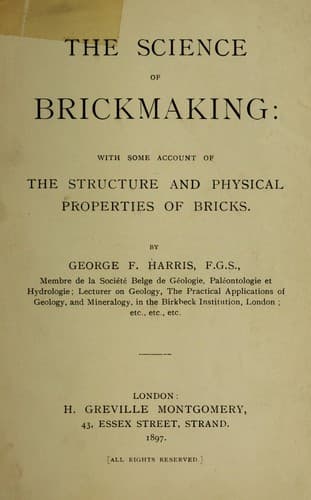
The Science of BrickmakingHarris, George Frederick
Science
The Science of Brickmaking
Harris, George Frederick
Brickmaking -- Handbooks, manuals, etc.
The reader may be tempted to enquire, What is the use of knowing the
micro-structure of a brick? We have anticipated the question to some
extent in dealing with the structure of brick-earths, but it may be
well to enlarge upon it here. In the first place, the study of the
minute structure enables the manufacturer to ascertain whether the
brick is thoroughly and homogeneously burnt. It tells him whether the
materials mixed together in the earlier stages of manufacture were
thoroughly incorporated or not, whereby, if need be, he can improve
that part of the process. In carefully examining what the average
manufacturer would call a well-burnt brick, the microscope assists us
in perceiving that it is often anything but well burnt, small local
patches--“tears”--of semi-vitrified matter being observed, which
should not exist, of course, in a perfectly homogeneous brick. And if
the brick is not homogeneous, it suffers in respect of its strength
as a whole, and in the majority of cases its colour is not uniform.
To arrive at the cause of this lack of uniformity is to indicate the
manner in which the manufacture of the brick may be improved, and the
microscope often enables us to arrive at a satisfactory solution of the
problem.
From a chemical standpoint we know that a high percentage of iron in
the average brick-earth is not conducive to the production of a good
brick. In the same manner by “rule of thumb” we learn that a high
percentage of lime prevents the manufacture of the raw material into
a fire-brick, unless, indeed, we are making basic bricks. The chemist
tells us also of the respective values of potash and soda. Too much
iron will cause the brick to “run”; salt has a similar effect; but
beyond this the chemist cannot go, except that in the broad sense he
explains what unions take place to produce such results.
The microscope, on the other hand, enables one to see exactly what
has taken place; the deleterious constituents are detected at their
work, and careful chemical investigation teaches us what to add to the
brick-earth to neutralise the effects observed; for it is only from
its effects that the artificial constitution of the brick-earth can be
properly regulated.
Public-domain text, read in full here on John Shaqi.
Reviews
Reviews
No reviews yet
Be the first to share your thoughts on this work.
Elsewhere in the archive
Join the Discussion
Join the discussion
Sign in to leave a comment or review.
Sign InorCreate an account