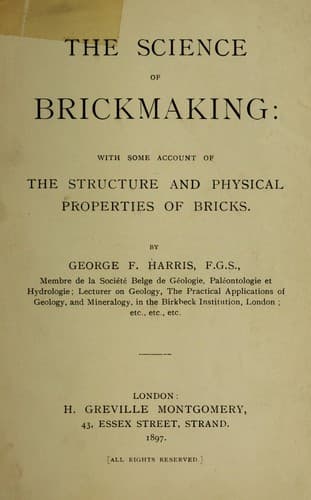
The Science of BrickmakingHarris, George Frederick
Science
The Science of Brickmaking
Harris, George Frederick
Brickmaking -- Handbooks, manuals, etc.
The same instrument is extremely useful in all questions concerning
the relations subsisting between a brick and the glaze upon it, the
cause and prevention of the cracking of the latter, and its general
quality from a physical aspect. And, speaking of cracks, we may
again draw attention to the influence these have on the strength and
durability of the brick: many of these minute fissures cannot be seen
by the naked eye. In a similar way can the microscope be made use of
in the manufacture of terra-cotta and faïence. The cracking of glazes
is one of the most troublesome features the high-class brick and
tile manufacturer has to deal with. If the character of the surface
of the brick is not suitable for “taking” the glaze, the maker knows
in a moment; the trouble is where the glaze takes readily and then,
some time after the operation is finished, it becomes covered with
“spider-web” cracks, unsightly and considerably detracting from the
value of the brick. The cause of the cracking is commonly attributed
to the composition of the glaze, and the manner in which the latter is
allowed to cool, and no doubt a great deal is due on both those heads.
At the same time, we know of many instances where the same glaze being
used under similar conditions on two different surfaces of bricks made
from one and the same brick-earth, the glaze cracks in the one case,
and hardly ever in the other. The direction of the cracks points to
their origin, and the character of the surface is brought in guilty.
And yet the average manufacturer would not detect any difference in the
quality of the surface--he could not, without a good lens or low power
objective, perceive the slightest discrepancy.
The ordinary glaze behaves very much like Canada balsam with
reference to surfaces on which it is laid, and something akin to what
petrologists call “perlitic” cracks is produced in the glaze. We can
make these cracks, and imitate the structure artificially, by suitably
distributing the Canada balsam over the surface of a piece of ground
glass, and in other ways. That direct relationship exists between
the cracks and the grain of the surface on which the preparation is
laid, is certain, for we may vary the distribution of the cracks by
varying the grain of the surface. An intelligent appreciation of the
disposition of cracks in glazes should be the means of preventing them
altogether, and not only with bricks, but with faïence and vitrified
work generally, the study may be best carried on by aid of the
microscope.
The microscope, also, may be made use of in identifying bricks in
case of dispute, though its applications in this respect are not so
important as in dealing with building stones.
Public-domain text, read in full here on John Shaqi.
Reviews
Reviews
No reviews yet
Be the first to share your thoughts on this work.
Elsewhere in the archive
Join the Discussion
Join the discussion
Sign in to leave a comment or review.
Sign InorCreate an account