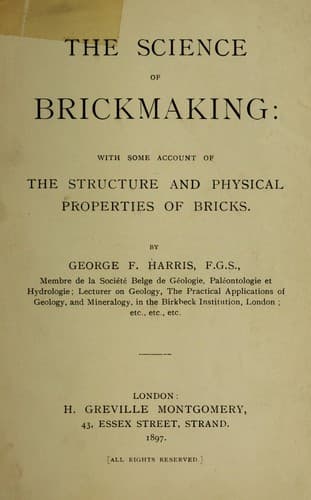
The Science of BrickmakingHarris, George Frederick
Science
The Science of Brickmaking
Harris, George Frederick
Brickmaking -- Handbooks, manuals, etc.
Questions of durability may frequently be decided on appeal to that
instrument. Take a case in which a brick is known to contain a rather
high percentage of lime: if the lime were in a combined state, the
quality of the brick would not be materially affected; but assuming
it were not so employed, it is possible that in a short space of time
the brick would be thoroughly decomposed by atmospheric agencies. The
microscope tells us at a glance the state in which that and other
ingredients exist, in a well-burnt brick. We draw the line at bricks
intended for the “jerry” builder; they may well be left to take care of
themselves; we allude only to high-class productions in which science
may be some aid to the manufacturer.
And now as to the microscope--for we do not use an ordinary one in
such investigations. The best kinds of microscope are those used
by petrologists in the study of the minute structure of rocks and
minerals. The reader will find these fully described in works specially
devoted to the subject,[13] but we may say a few words thereon.
A common form of “Student’s” petrological microscope, as manufactured
by Swift of London, may be described as follows:--
_Eye Pieces and Objectives._--These need not be expensive, clear
definition being the principal object to aim at; the objectives should
be of low power, 2-inch, 1-inch and ½-inch objectives being plenty
for the purpose. Unless the reader desires to follow the subject
from a purely petrological point of view, to study the development of
trichites, globulites, skeleton crystals, etc., in vitrified bricks,
in such places as these latter have cooled from igneous fusion,
there is no occasion to resort to higher powers. We are far from
saying that the brickmaker of the present day would not derive any
advantage from studying this subject in its higher aspects, for the
origin of crystallization appeals strongly to the imaginative mind,
and is one of the most remarkable problems that Nature offers for our
investigation. But in an elementary treatise of this kind we cannot go
into the matter; and, as previously remarked, low power objectives are
sufficient for our present purpose. The eye-pieces should be fitted
with cross-wires, the use of which will presently be explained.
Public-domain text, read in full here on John Shaqi.
Reviews
Reviews
No reviews yet
Be the first to share your thoughts on this work.
Elsewhere in the archive
Join the Discussion
Join the discussion
Sign in to leave a comment or review.
Sign InorCreate an account