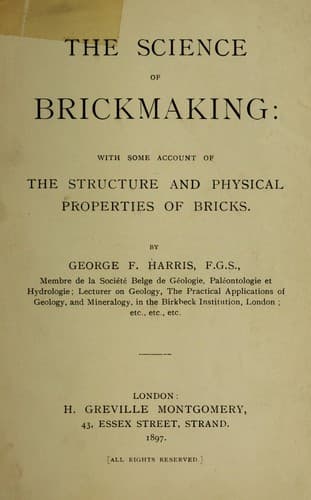
The Science of BrickmakingHarris, George Frederick
Science
The Science of Brickmaking
Harris, George Frederick
Brickmaking -- Handbooks, manuals, etc.
A. Milk white, or more rarely light pink; the mineral, even when red in
the raw earths, becomes white on the application of moderate heat, as
in the burning of common bricks. It is often closely fractured, and but
rarely powdered.
B. The characteristic parallel lines of the triclinic varieties may
often be observed, especially in rubber bricks; but great heat, such
as leads to partial peripheral fusion, frequently obliterates them
to a large extent, and in a well-burnt brick it is quite impossible
in the majority of cases to determine whether the felspars present
are triclinic or monoclinic. More particularly is this the case when
the mineral has been more or less decomposed prior to its having been
burnt. The bulk of the fragments of the mineral can only be alluded to
in the general term “felspars,” and in ordinary light these are opaque
or “fleecy,” whilst in polarised light minute portions may be found to
be slightly birefringent. In a decomposed state it forms a prominent
constituent of brick-earths in the first place, and that is precisely
the material which most readily agglutinates in presence of a suitable
flux. Crystallites are not uncommon in the melted peripheries, as may
be seen in a hard-burnt brick in ordinary light.
MICA.--In minute flakes, shining, or glistening, and commonly black,
silvery or bronze-coloured.
A. Detected at once by its thin shining scales, which frequently have
not suffered much in the kiln except near the outside of the brick.
B. 1--The darker micas are usually citron coloured or light brown,
and unless cut parallel to the cleavage of the mineral, exhibit a
number of closely-set parallel lines, the fragments being much “frayed
out” and “ragged” at the edges. 2--Using one nicol only, the mineral
changes from dark to light on the revolution of the stage, and is said
(in common with other minerals exhibiting a similar property) to be
dichroic. With both nicols in position but little further difference is
noted, except that in changing tint the whole is darker. Vivid colours
are not observed except in yellows and browns. Muscovite mica is often
quite white and transparent.
IRON.--Common except in white bricks made from the purest china-clays.
A. Brown or reddish-brown specks; sometimes as blue black films in
fire-bricks; dull and frequently powdery in common bricks. Surrounding,
film-like, grains of mineral matter of which the brick is composed.
A grain of quartz, for instance, is frequently seen enveloped by a
film of red iron. Other metallic iron is more lustrous and whiter than
magnetite when seen in reflected light, but such unaltered particles of
the mineral could only occur in a brick that had not been subjected to
great heat.
B. Opaque either in 1 or 2.
Public-domain text, read in full here on John Shaqi.
Reviews
Reviews
No reviews yet
Be the first to share your thoughts on this work.
Elsewhere in the archive
Join the Discussion
Join the discussion
Sign in to leave a comment or review.
Sign InorCreate an account