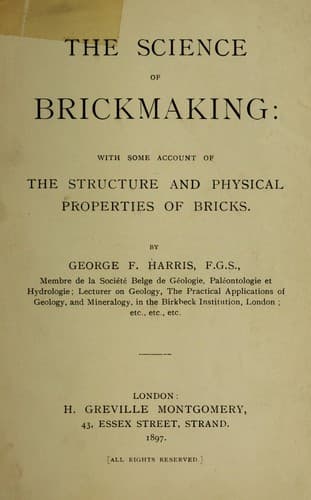
The Science of BrickmakingHarris, George Frederick
Science
The Science of Brickmaking
Harris, George Frederick
Brickmaking -- Handbooks, manuals, etc.
IRON PYRITE only occurs as such in bricks that have not been thoroughly
burnt, or in common “baked” bricks. Higher temperatures lead to the
separation of the iron from the sulphur and the general incorporation
of both in the agglutination of the brick during partial fusion.
A. Brassy yellow particles.
B. Opaque both in 1 and 2.
CALCITE.--Not found in burnt bricks, nor indeed in any except those
that have been sun-dried, or have been subjected to very little heat.
Small pellets of lime are of common occurrence in poorly-burnt bricks.
In reflected light such pellets are generally of a dirty white tint;
opaque in transmitted light.
DOLOMITE.--Practically the same observations apply as to calcite,
crystals of dolomite not being found except in sun-dried bricks and
the like. Under the action of much heat the mineral, like calcite, is
reduced to lime.
SELENITE.--This is not rare in the commoner class of bricks, though
the application of much heat reduces it to the state of powder. In
reflected light it is found to be present as extremely minute specks or
“tears” of whitish powdery plaster. Opaque, of course, in transmitted
light.
The description of the micro-appearance of many other minerals which
occur but rarely in bricks does not fall within the scope of the
present elementary treatise; for practical purposes they may be
ignored.
CHAPTER XIII.
ABSORPTION.
The advantage of knowing the relative absorptive capacity of bricks has
been stated in these pages in divers connexions. The means of arriving
at the total capacity for absorption of water, as generally practised
by experimenters, are very incomplete and founded on an erroneous
principle. It is admitted by all that absorption is one of the very
best tests as to the quality of a brick, but such tests are meaningless
unless they imitate one or other or several of the influences to which
the brick would be subjected on being used in the building, or other
structure.
A common method is to weigh the brick when dry and then to immerse
it in water for periods varying from one to three days, subsequently
re-weighing it, the difference in weight between the dry and wet states
being termed the brick’s “absorptive capacity.”
Mr. Heinrich Ries remarks[16] that the absorption is determined by
weighing the thoroughly dry samples, immersing in clean water from
48 to 72 hours, then wiping dry and weighing again. Vitrified bricks
should not show a gain in weight of over 2 per cent. There are cases
where bricks of apparently good quality shew a greater absorption than
this, but they have great toughness and refractory qualities. Bricks
made from fire-clays which will not vitrify so easily will, naturally,
show higher absorption.
Public-domain text, read in full here on John Shaqi.
Reviews
Reviews
No reviews yet
Be the first to share your thoughts on this work.
Elsewhere in the archive
Join the Discussion
Join the discussion
Sign in to leave a comment or review.
Sign InorCreate an account