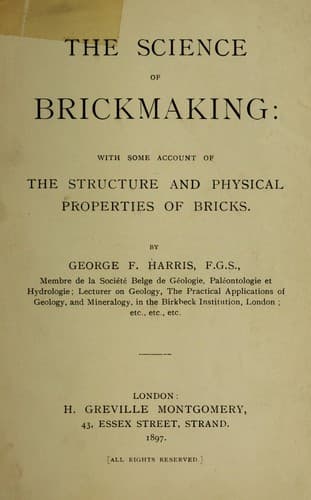
The Science of BrickmakingHarris, George Frederick
Science
The Science of Brickmaking
Harris, George Frederick
Brickmaking -- Handbooks, manuals, etc.
A writer in the _Builder_ of May 25th, 1895, p. 397, experimented as
follows:--The bricks were placed in water in a large vessel, on edge,
supported where necessary by flat blocks, to bring the uppermost face
of each brick about ¼-inch above the surface of the water. Experience
had shewn that by completely immersing a brick, the air did not get
an opportunity of escaping from its pores with the same facility as
when one surface was left out of water. This disability, it was found,
materially impaired the results of the rate of absorption (rate, as
well as total tests, being carried out). By arranging the experiments
in the manner described, there can be no doubt that each brick absorbed
the maximum quantity of water possible; at any rate, there was no
water-pressure from above to retard the expulsion of the air.
The tests in the last-mentioned case extended over one week, the
relative absorption being taken at intervals of 1 second, 1 minute, 30
minutes, 1 day, and at the end of the week. It was found that English
vitrified bricks absorbed from 1.16 to about 1.85 per cent. in one
week; white glazed and good red and blue facing bricks from 5.31 to
10.34 per cent. in one week; wire cut facers and rubbers, with white
gaults, imbibed as much as from 12.93 to 20.50 per cent. of their dry
weight in one week. The rate of percolation suggested many interesting
problems, not the least important being the effect of chemical
decomposition in prolonged immersions, whereby after being quiescent
for a few days (after taking in the water for a few hours), absorption
“burst out” again and continued to the end of the week. One thing is
very apparent from this, namely, that for the lower grade brick even an
immersion for one week is not sufficient for practical purposes. The
writer remarks, “some of the red bricks from Bracknell, being placed
in the vicinity of the white gault bricks (in the water), discoloured
the latter to such an extent as to disfigure them. It was not merely a
surface colouration; it extended to at least ¼-in. into the interior.
The red colouring matter was iron, but there was not enough of it by
weight dissolved to materially interfere with the experiments. This
very clearly shews, however, the folly of erecting a building coursed
with white and red bricks, when both are very absorbent and the red has
so little hold of the iron of which it is partly composed--unsightly
stains are bound to appear.”
This question of the solubility of certain ingredients of bricks, has
not received the attention it deserves; and closely connected with
that is gradual decomposition, whereby the brick becomes more and more
porous--a potent factor in its ultimate destruction.
CHAPTER XIV.
STRENGTH OF BRICKS.
Public-domain text, read in full here on John Shaqi.
Reviews
Reviews
No reviews yet
Be the first to share your thoughts on this work.
Elsewhere in the archive
Join the Discussion
Join the discussion
Sign in to leave a comment or review.
Sign InorCreate an account