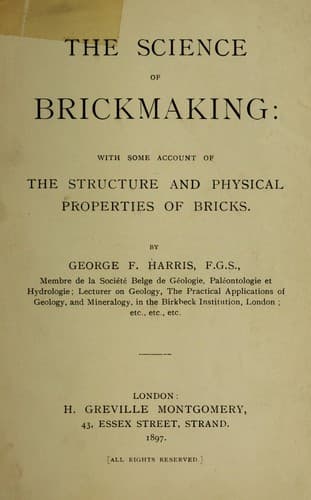
The Science of BrickmakingHarris, George Frederick
Science
The Science of Brickmaking
Harris, George Frederick
Brickmaking -- Handbooks, manuals, etc.
Again, Mr. E. S. Fickes, of Steubenville, Ohio, has recently made[17] a
large series of valuable tests of both paving and building bricks, in
which he shews the connexion between the power of absorption and the
strength of the materials experimented with. Mr. Fickes’ more important
conclusions are:--
1. The strength of the building brick, both transverse and crushing,
varies in tolerably close inverse ratio with the quantity of water
absorbed in twenty-four hours. The strongest bricks absorb the least
water.
2. Good building bricks absorb from 6 to 12 per cent. in 24 hours, and
with no greater absorption than 12 per cent. will ordinarily show from
7,000 to 10,000 or more pounds per square inch of ultimate crushing
strength.
3. Poor building bricks will absorb one-seventh to one-fourth of their
weight of water in 24 hours, and average a little more than one-half
the transverse and crushing strength of good bricks.
4. An immersed brick is nearly saturated in the first hour of
immersion, and in the remaining 23 hours the absorption is only
five-tenths to eight-tenths of 1 per cent. of its weight, as a rule.
These experiments are of much interest and are probably approximately
correct; but we venture to think that if the absorption experiments had
been carried out in a different manner, the results would have been
still more valuable.
Long before the publication of the results of the last mentioned series
of experiments, the present writer had discovered the close connexion
which subsists between the relative absorptive capacity of bricks and
their strength; a slight correction must be applied for specific
gravity. We are not prepared to enter into this subject at any length,
but it may be observed that we should not have arrived at such close
results had we experimented in the same way as the American authors
just quoted (or others, for the matter of that).
When you completely immerse a brick in water you prevent the escape of
air to a very large extent from the pores in the interior of the brick.
An old-fashioned way of overcoming this difficulty, was to place the
brick in the receiver of an air-pump and exhaust the air, subsequently
immersing the brick. This latter method certainly possessed the merit
of enabling the experimenter to arrive at total absorption very
rapidly, but it did not imitate natural processes any more than does
the thorough immersion of the brick in water.
Public-domain text, read in full here on John Shaqi.
Reviews
Reviews
No reviews yet
Be the first to share your thoughts on this work.
Elsewhere in the archive
Join the Discussion
Join the discussion
Sign in to leave a comment or review.
Sign InorCreate an account