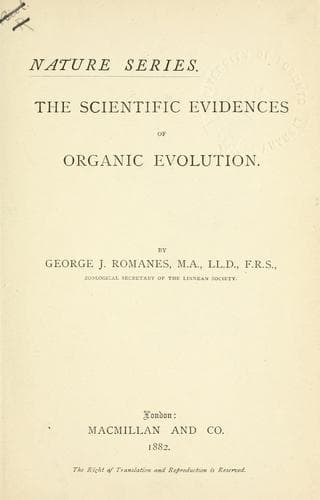
The Scientific Evidences of Organic EvolutionRomanes, George John
Science
The Scientific Evidences of Organic Evolution
Romanes, George John
Evolution
Turning next to the case of oceanic islands, situated at some distance
from a continent. In these cases the plants and animals found on the
island, though very often differing from all other plants and animals in
the world as regards their specific type, nevertheless in generic type
resemble the plants and animals of the neighbouring continent. The
inference clearly is, that the island has been stocked from the
continent with these types--either by winds, currents, floating trees,
or numerous other modes of transport--and that, after settling in the
island, some of these imported types have retained their specific
characters, while others have varied so as to become specific types
peculiar to that island. The Galapagos Archipelago islands are
particularly instructive in this connection; for while the whole group
of islands lies at a distance of over five hundred miles from the shores
of South America, the constituent islands are separated from one another
by straits varying from twenty to thirty miles. Now, to quote from
Darwin, "Each separate island of the Galapagos Archipelago is tenanted,
and the fact is a marvellous one, by many distinct species; but these
species are related to each other in a very much closer manner than to
the inhabitants of the American continent." That is to say, the
American continent being some fifteen times the distance from these
islands that they are from one another, emigration to them from the
continent is of much more rare occurrence than emigration from one
island to another; and therefore, as more time for variation is thus
allowed, while the differences between the inhabitants of island and
island are only specific, the differences between the inhabitants of the
islands as a group and the inhabitants of the American continent are
very often generic. I may mention, in passing, that it was upon
discovering these relations in the case of the Galapagos Archipelago,
and pondering upon them as "marvellous facts," that Mr. Darwin was first
led to entertain the idea that the doctrine of descent might be the
grand truth for which the science of the nineteenth century was waiting.
Public-domain text, read in full here on John Shaqi.
Reviews
Reviews
No reviews yet
Be the first to share your thoughts on this work.
Join the Discussion
Join the discussion
Sign in to leave a comment or review.
Sign InorCreate an account