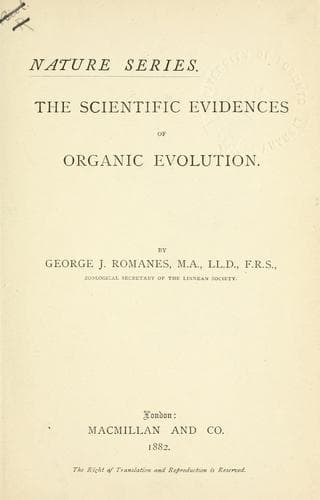
The Scientific Evidences of Organic EvolutionRomanes, George John
Science
The Scientific Evidences of Organic Evolution
Romanes, George John
Evolution
But having now concluded this brief review of the leading arguments in
favour of organic evolution, and having expressed as forcibly as I am
able my own opinion upon them, I do not wish it to be supposed, either
that I am intolerant of opinions which are held by others, or that I
have been trying to, "make out a case" by suppressing adverse facts. I
am not intolerant, because I believe that dissent from the general
doctrine of evolution can only arise either from ignorance of some
special departments of science, or from a bias of feeling against the
doctrine--to both of which weaknesses evolutionists can afford to be
indulgent. And in order to show that I have not been trying unfairly to
make out a case, I shall conclude by briefly reviewing the arguments
which have been adduced against the doctrine in question.
The only argument of this kind that I know from the side of reason (if
we neglect those special objections which have been fully shown by Mr.
Darwin himself to be based on inadequate information or erroneous
conception, and therefore futile), is that which says:--Evolution, if
true, can only be proved so by an actual observation of the process, and
as no one pretends to have witnessed the transmutation of species, it
follows that evolution has not been proved.
Now, it is perfectly right to draw a clear distinction between a theory
and a demonstration; but it is a great mistake to suppose that a theory
may then only be admitted by science when it has been demonstrated.
Bishop Butler tells us that "Probability is the guide of life," and not
less true is it that probability is likewise the guide of science. The
business of science, as of common life, is to estimate correctly the
relative degrees of probability presented by this and that theory or
hypothesis; when once a theory or hypothesis is demonstrated it ceases
to be a matter of scientific inquiry, and becomes a matter of scientific
fact. Thus received, we have to consider the doctrine of evolution as
certainly standing in the first rank of scientific theories in respect
of probability sustained by evidence, although no less certainly not
demonstrated as a matter of scientific fact. But when a theory has been
raised to such a level of probability as this, it is, for all practical
purposes, as good as a demonstration. Thus, in the particular instance
before us, even if the sceptical demand for evidence, which from the
nature of the case is clearly impossible, were granted, and if we could
actually observe the transmutation of species, the fact would not exert
any further influence on the progress of science than is now exerted by
the large and converging bodies of evidence which leave no other
rational theory open to us than that such transmutation has taken place.
Therefore, it seems to me, the hypercritical objection which we are
considering is really founded on a misconception of scientific method,
and of what it is that justifies a scientific doctrine. Assuredly, in
Public-domain text, read in full here on John Shaqi.
Reviews
Reviews
No reviews yet
Be the first to share your thoughts on this work.
Join the Discussion
Join the discussion
Sign in to leave a comment or review.
Sign InorCreate an account