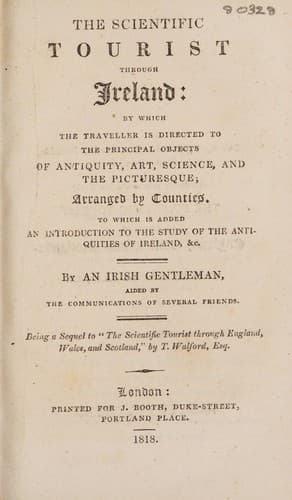
The Scientific Tourist through Ireland: in which the traveller is directed to the principal objects of antiquity, art, science & the picturesqueWalford, Thomas
History
The Scientific Tourist through Ireland: in which the traveller is directed to the principal objects of antiquity, art, science & the picturesque
Walford, Thomas
Ireland -- Description and travel
GOWRAN, 8 m. E. of Kilkenny, stands on a pleasant stream.--See Ch.
in ruins, a fine specimen of the middle Gothic. In the cemetery are
the bones of the officers of the Castle garrison shot by order of
Cromwell for their gallant defence. See Low Grange, 1 m., modern
mansion erected on ruins of ancient Castle. Visit Graignemanach lying
in a sequestered vale on the romantic banks of the Barrow, which
claims the tourist's notice by majestic ruins of an extensive Abbey,
of which the architecture and sculpture excite our admiration even in
its present dilapidated state. It is built in the form of a cross; and
its outline pretty entire. The arch leading into the choir, rising to
the roof with double mouldings and supported by clustered pillars, is
a very fine specimen of the Gothic. It is impossible to view the two
plates of it given by Grose, without wishing to explore its venerable
arcades. It was a mitred Abbey, and founded in 1212; but particularly
remarkable for having been the depository of a "Doomsday Book," or
Survey of the Island, begun by Henry II., and finished under the
orders of John.
KILKENNY, the county town, is 57 m. S.W. of Dublin.--The Castle is an
interesting object to the inquisitive tourist, originally begun in
the 12th century by Strongbow, and completed by William de Mareschal,
Earl of Pembroke. Great part of the ancient edifice has survived the
various convulsions of civil anarchy, now repaired and beautified so
as to form a conspicuous ornament to the city, on a rising ground,
with a rapid descent to the Nore, and on the other sides fortified by
walls and towers, the Gothic grandeur of whose remains is disfigured
in the eye of taste, by a lofty marble entrance gate of the Corinthian
order. Much fine tapestry, in fresh and lively colours, representing
the story of Decius, will interest the visitor on entering the
breakfast-room. See also the alcove or presence-chamber, hung with
tapestry, with a chair of state raised a step above the floor, a
remnant of ancient pomp, now superseded by the simpler habits of
modern nobility. The other parts of the mansion have also been well
fitted up for the fashionable conviviality which has recently graced
its walls. The ball-room or gallery is of great length, and contains
pictures, many of which are highly interesting, being the portraits of
the gay court of the 2d Charles. See also the Countess's Dressing-room
in an octagon tower; the Chapel, and, if permitted, the Evidence
Room, which contains an immense mass of valuable MSS., materials
partially gleaned by Carte, the historian. Near the city is the
Cathedral Ch. of St. Canice, of considerable antiquity, being, in its
finished state, of the reign of Edward the 1st, and still in very good
preservation. It stands on an eminence, with a descent on all sides;
and the Ch. yard is entered, from the town, by a flight of marble
steps. The cemetery being planted with trees has a romantic effect,
Public-domain text, read in full here on John Shaqi.
Reviews
Reviews
No reviews yet
Be the first to share your thoughts on this work.
Elsewhere in the archive
Join the Discussion
Join the discussion
Sign in to leave a comment or review.
Sign InorCreate an account