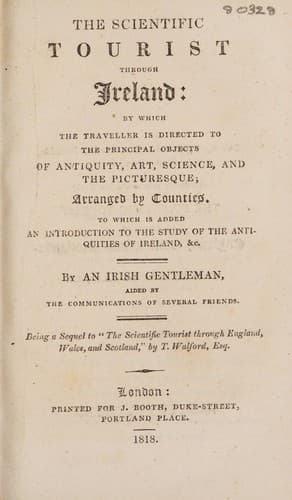
The Scientific Tourist through Ireland: in which the traveller is directed to the principal objects of antiquity, art, science & the picturesqueWalford, Thomas
History
The Scientific Tourist through Ireland: in which the traveller is directed to the principal objects of antiquity, art, science & the picturesque
Walford, Thomas
Ireland -- Description and travel
and presents a very extensive prospect over a rich vicinage. In the
interior the seats of the choir and gallery are of oak varnished, and
the whole plain, but remarkably neat. The compass ceiling is adorned
with fretwork, and has many modillions, and in the centre a group
of foliage, festoons, and cherubim. In the nave and aisles are many
beautiful sepulchral Monuments. It is the Cathedral of the see of
Ossory; and close to it is a very curious Round Tower. The Dominican
or Black Abbey, an extensive ruin, with the elegant ramifications
of some of its Gothic windows in pretty good preservation, stands
low, and is surrounded by squalid huts, which disfigure its outside
and take off much of the sombre effect of its venerable walls. The
windows, especially the east one, are light and elegant: the arcades
are open and airy; and the towers spring up with an airy elegance
that seizes at once upon the traveller's attention. The Abbey of
St. Francis, with its square Tower springing from a lofty Gothic
arch, is worthy the tourist's notice, though much disfigured in its
interior by the squalid cabins of poverty and idleness, and by part
of its precincts being turned into a horse barrack. The great altar
is a marble slab of amazing size; but perhaps the most remarkable
circumstance about the place is the legendary story of a sainted lady
who built part of the choir, and whose extreme chastity induced her
to descend a virgin into the grave at the age of 70, although she had
been married young and to several husbands. The ruins of St. John's
Abbey, part of which has been converted into a foot barrack, present
some very fine specimens of the light Gothic in the windows and
corridors. Founded in 1220. See the marble mill, about 2 m. from the
city, and on the left bank of the river; a very ingenious invention,
alike admirable for the simplicity of its construction, and for the
power which it exerts. The saws are made of soft iron, and will last
but a week; each cutting about ten or twelve inches per day, equal to
the labour of two men. Not far from these mills are various marble
quarries; but the most curious mineralogical specimen is called
Sidero-calcite, so plentiful as to have been used for repairing the
roads. Unlike the other marbles, it cannot be burnt into lime; but it
contains a quantity of iron and manganese; and as it is brittle and
friable, it has been proposed as an ingredient in mortar or cement
used for building under water. Visit Clogmanta Hill, about 10 m.
N.W., where are some extensive Druidical remains, with a magnificent
prospect from the summit. Rathbeath, 5 m. N., is supposed to be the
ancient Argat-Ross, where in early times a silver mine existed, whence
the first Irish coinage took place.
Public-domain text, read in full here on John Shaqi.
Reviews
Reviews
No reviews yet
Be the first to share your thoughts on this work.
Elsewhere in the archive
Join the Discussion
Join the discussion
Sign in to leave a comment or review.
Sign InorCreate an account