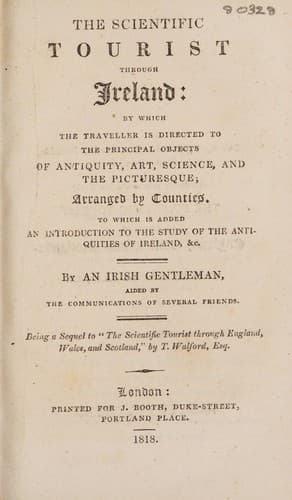
The Scientific Tourist through Ireland: in which the traveller is directed to the principal objects of antiquity, art, science & the picturesqueWalford, Thomas
History
The Scientific Tourist through Ireland: in which the traveller is directed to the principal objects of antiquity, art, science & the picturesque
Walford, Thomas
Ireland -- Description and travel
DROGHEDA, 18 m. S. of Dundalk, (partly in Louth, partly in Eastmeath,
being divided by the Boyne) is also a county of itself. Here are 9
Catholic chapels, 2 Friaries, 2 Nunneries, and 1 Ch. (St. Peter's)
elegantly finished, near which, in churchyard, see remains of ancient
castle. The view on approaching the town is beautiful; house of the
Catholic primate a striking object. Harbour good; trade extensive;
supply of fish excellent. See Tholsel, a handsome edifice. St. Mary's,
now a mere mass of ruins, with the exception of a roofed chapel, which
is used for divine service; but it deserves notice for a lofty arch at
the S. end, which marks the former splendour of the edifice. Bevrac
Mount, a large artificial tumulus, stands about 600 yards distant. It
appears to have been one of the large Raths raised in ancient times.
The town is interesting for the part it bore in the Irish wars; and
sustained a memorable siege in Cromwell's time. Near it is a thin
blue stone, shaped like the bottom of a boat, on which many of the
Catholics believe St. Dennis sailed over to France. Ascend the Boyne 2
m., and visit the field of battle where William conquered, and where
Schomberg fell, also Walker the patriotic defender of Derry. The view
of the scene from a rising ground, looking down upon it, is extremely
fine. Mark the vale losing itself amidst bold acclivities; on the
right the Obelisk on a rising ground, a noble pillar and judiciously
placed. Let the tourist place himself at its foot, and recall the
events of past times! Then proceed further 9 m. W. of Drogheda, where
is a beautiful wooded glen celebrated as the route through which King
William's army marched to the ford in the Boyne water on the eventful
1st of July, 1690. The scenery around is highly interesting. Collon
village, 6 m. distant, must not be omitted by the statistical tourist,
as an instance of what can be done in Ireland by modern improvement.
The exertions of Mr. Foster, in this place, have been well appreciated
by Mr. Wakefield, who describes it as delightfully situated amongst
hills, whilst the extensive plantations of its benevolent founder are
conspicuous in every direction for many miles. Mr. W. adds, that this
domain commands a prospect of singular magnificence; the immediate
foreground, looking N.E., consists of a declivity of tilled land
bordered on each side by beautiful plantations; and the eye, then
passing over some miles of country, catches a view of Carlingford-bay,
forming a watery expanse of great extent, and of the coast stretching
to a considerable distance, with the mountains surrounding the
bay, and those of Mourne, still higher, and which have a blacker
appearance. The blue colour of the bay, contrasted with the yellow
tint of the sandy beach by which it is bordered, the Carlingford
mountains in the vicinity, and the more elevated dusky ones of
Mourne, stretching inland in the form of an immense amphitheatre,
form, in Mr.
Public-domain text, read in full here on John Shaqi.
Reviews
Reviews
No reviews yet
Be the first to share your thoughts on this work.
Elsewhere in the archive
Join the Discussion
Join the discussion
Sign in to leave a comment or review.
Sign InorCreate an account