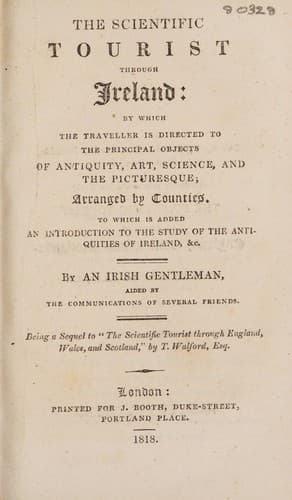
The Scientific Tourist through Ireland: in which the traveller is directed to the principal objects of antiquity, art, science & the picturesqueWalford, Thomas
History
The Scientific Tourist through Ireland: in which the traveller is directed to the principal objects of antiquity, art, science & the picturesque
Walford, Thomas
Ireland -- Description and travel
W's opinion, a spectacle grand and magnificent. The
village, when he visited it, consisted of about one hundred neat
houses, all whitewashed; with a Ch. surrounded by trees, and a river
running through it, over which there is a stone bridge; the whole
much enlivened by a bleaching-green on its banks. All this, together
with a cotton manufactory, has been the labour of 40 years. It is
highly worthy of notice, and is easily accessible by the good roads
in its vicinity. The botanist will receive much pleasure from the
inspection of the very fine collection of indigenous and exotic shrubs
which Mr. Foster has collected round his comfortable mansion. See
also _Curwen's Letters_, vol. ii. p. 292. Observe the Ch. tower, of
chaste Gothic architecture; the curious winter garden. In a romantic
valley, 5 m. W. from Drogheda and about 1-1/2 m. from the banks of the
Boyne, stand the once massy but now dilapidated ruins of Mellifont
Abbey, founded for Cistertian monks, by O'Carrol prince of Uriel, in
the 12th century, and a spot of great interest in the history of the
English invasion of Ireland; for here died, and now lies interred,
Dervorgilla, daughter of O'Malaghlin, king of Meath, a second Helen,
who being married to Tigernach O'Rourke prince of Brefinny, was basely
ravished by Mac Murrogh king of Leinster, who was in consequence
forced to fly from his dominions, and sought that succour from Henry
II. which led to the subjugation of the island. At the Dissolution it
was given to Sir Edward Moore, who made it a castellated residence;
but it afterwards became a ruin, and within the last fifty years has
suffered extremely. The most curious part is a remnant of an octagonal
baptistery. See _Hoare_, p. 242. Monasterboice, a village about 3 m.
from Drogheda, has a good specimen of the ancient round towers, 110
feet in height and 51 in circumference, with walls of the thickness
of 3 feet 6 inches. The door is at present only 6 feet from the
ground; and it appears to have contained six stories, from the stones
that project in the interior. The tower itself is built of a slaty
stone, frequent in the hills in the vicinity; but the door is cased
of freestone. Its summit is already in decay. Near it are the ruins
of two Chapels; also two very curious crosses, the largest 18 feet in
height, with a variety of sculptures. A good view is given by Grose.
See _Hoare_, p. 237. Torfeckan village stands near the sea, and about
3-1/2 m. from Drogheda. It was once a place of some importance, though
now a paltry village, with nothing remarkable but some towers of its
ancient Castle, fast falling into decay; and connected with some ruins
of an Abbey founded for nuns in the 12th century. Till within these
few years the Castle had been habitable, and was a frequent residence
of the Archbishops of Armagh, to which see it belongs. See ruins of
Glasspistol Castle.
Public-domain text, read in full here on John Shaqi.
Reviews
Reviews
No reviews yet
Be the first to share your thoughts on this work.
Elsewhere in the archive
Join the Discussion
Join the discussion
Sign in to leave a comment or review.
Sign InorCreate an account